
Alpha isn’t your data. It’s the judgment your best people carry in their heads, and it deserves the same protection as anything else you’d never hand a competitor.
By The Chiri Team
If a competitor could read the internal reasoning behind your last ten decisions, would your advantage survive it?
For a lot of companies the honest answer is no, and the thing that would break is not a document or a database. It is the pattern underneath both, the accumulated judgment of the people who know why your business actually works, encoded nowhere except in how they operate day to day. That is what alpha means here, borrowed from a finance term for the edge a competitor cannot easily copy, and it is worth treating with the same seriousness a fund manager treats a proprietary strategy.
Why “your brain” is the right metaphor, not a marketing flourish
A company’s alpha rarely lives in a single system you can point to. It lives distributed across a handful of people who know which client relationships are actually fragile, which process shortcuts are safe and which ones aren’t, which numbers in a report are directionally right and which are noise. That knowledge behaves exactly like a brain, not a filing cabinet. It is contextual, it updates constantly, and it does not export cleanly into a document no matter how good your knowledge management process is.
Which is exactly why AI tools built around that knowledge deserve the scrutiny you would give any system with access to your actual thinking, not the scrutiny you’d give a spreadsheet. Palantir CEO Alex Karp made a version of this argument on CNBC in July 2026, telling Squawk Box that frontier AI labs are effectively “stealing weights and alpha” from the enterprises that use them, extracting the proprietary edge, not just the raw data. (CNBC) He has a commercial reason to say it loudly. The underlying mechanism he is describing is real regardless of who is pointing it out.
The mechanism is not theoretical, and a promise is not a protection
Even under a zero data retention agreement, there is a real, actively studied line of security research, membership inference and embedding inversion attacks, showing a model provider can sometimes infer meaningful signal about what was sent to it without retaining the raw prompt. That risk lives in the architecture, not in anyone’s intentions.
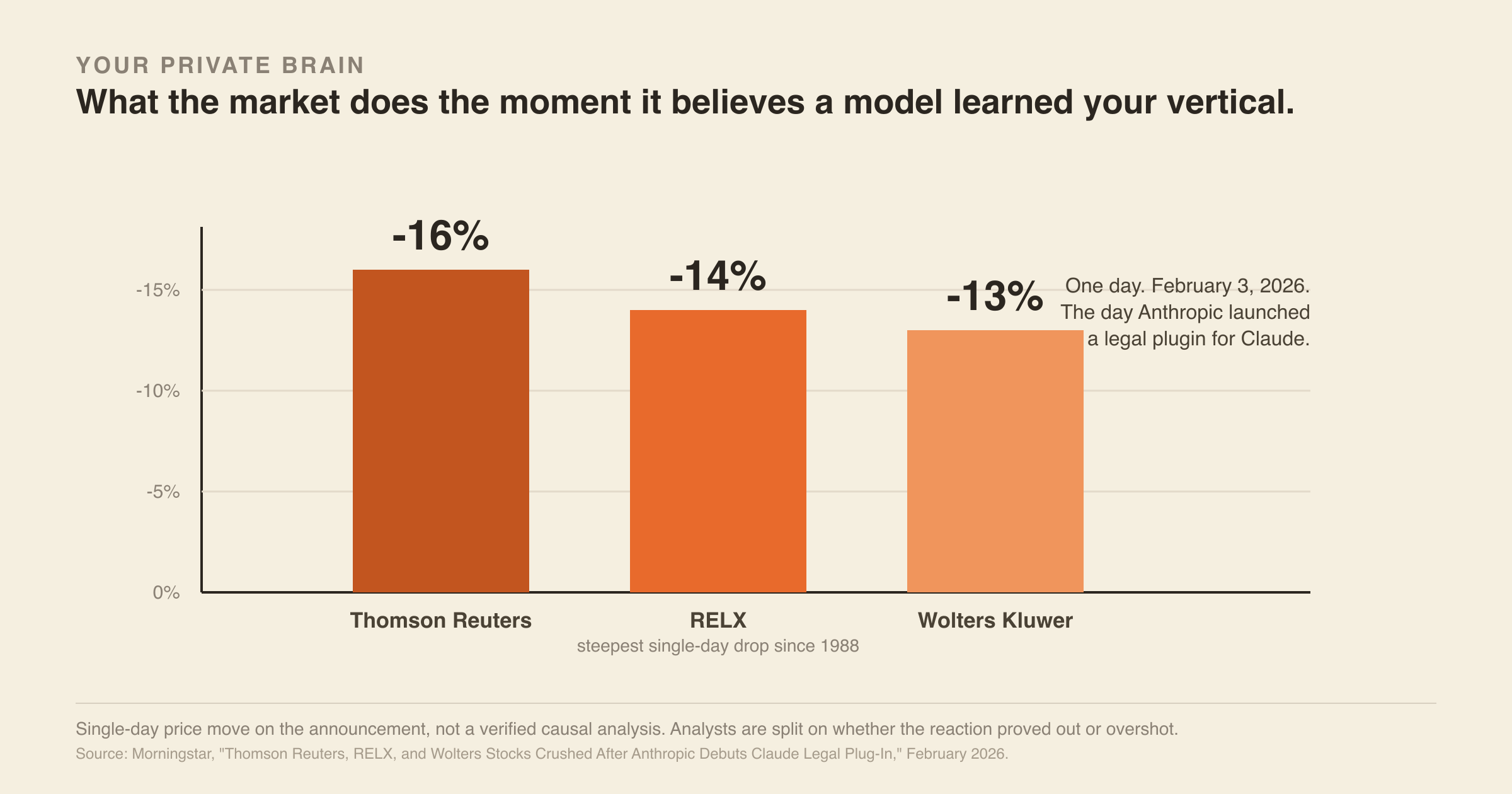
The aggregate version of this risk is already visible in the market. When Anthropic launched a legal plugin for Claude on February 3, 2026, a set of workflows shaped around how legal work actually happens, Thomson Reuters fell 16 percent that day and RELX fell 14 percent in its steepest single-day drop since 1988. Nobody signed a contract agreeing that their usage would train the next competing product in their category. The market reacted anyway, on the belief that it happens as a byproduct of aggregate patterns across thousands of customers. (Morningstar, February 2026)
The lesson is not that frontier models are unsafe to use. It is that a policy promise and a contractual restriction are different things, and only one of them is enforceable if it breaks.
What real protection actually requires
Real protection means the workflows that touch your alpha route through infrastructure with a data processing agreement that legally cannot be read for training purposes, not a settings toggle a vendor could quietly change. That is the standard we hold ourselves to with client data. It is not a courtesy. It is a structural limit on what we are contractually able to do, because your ontology, the pattern of how your business actually works, is the thing our own business exists to protect, not extract.
That distinction matters more as AI agents take on more of the actual work, not less. An agent that has learned your pricing logic, your escalation judgment, your client-specific exceptions has learned something closer to your institutional memory than to a dataset. The question worth asking about every AI vendor touching that layer of your business is not what they promise to do with it. It is what they are structurally unable to do with it, promise or no promise.
This is not only a CTO’s question to answer:
- The CEO is the one who has to explain to a board why a competitor suddenly moved faster on something that looked proprietary.
- The CFO is the one who has to price the risk of a vendor relationship into the value of the business itself, not just the IT budget.
- The CHRO is the one who understands, better than almost anyone else in the room, that the knowledge walking out the door every time a senior person leaves is the same knowledge this article is describing, just leaving through a different exit.
Which of your workflows right now would you least want to discover was training someone else’s product, and do you actually know the answer today or are you assuming it?
Sources cited:
- CNBC, “Palantir’s Karp bashes token-based AI model as ‘completely wrong,’” Alex Karp on Squawk Box, July 1, 2026. https://www.cnbc.com/2026/07/01/palantir-karp-open-ai-anthropic-tokens.html
- Morningstar, “Thomson Reuters, RELX, and Wolters Stocks Crushed After Anthropic Debuts Claude Legal Plug-In,” February 2026. https://www.morningstar.com/stocks/reuters-relx-wolters-stocks-crushed-after-anthropic-debuts-claude-legal-plug-in