
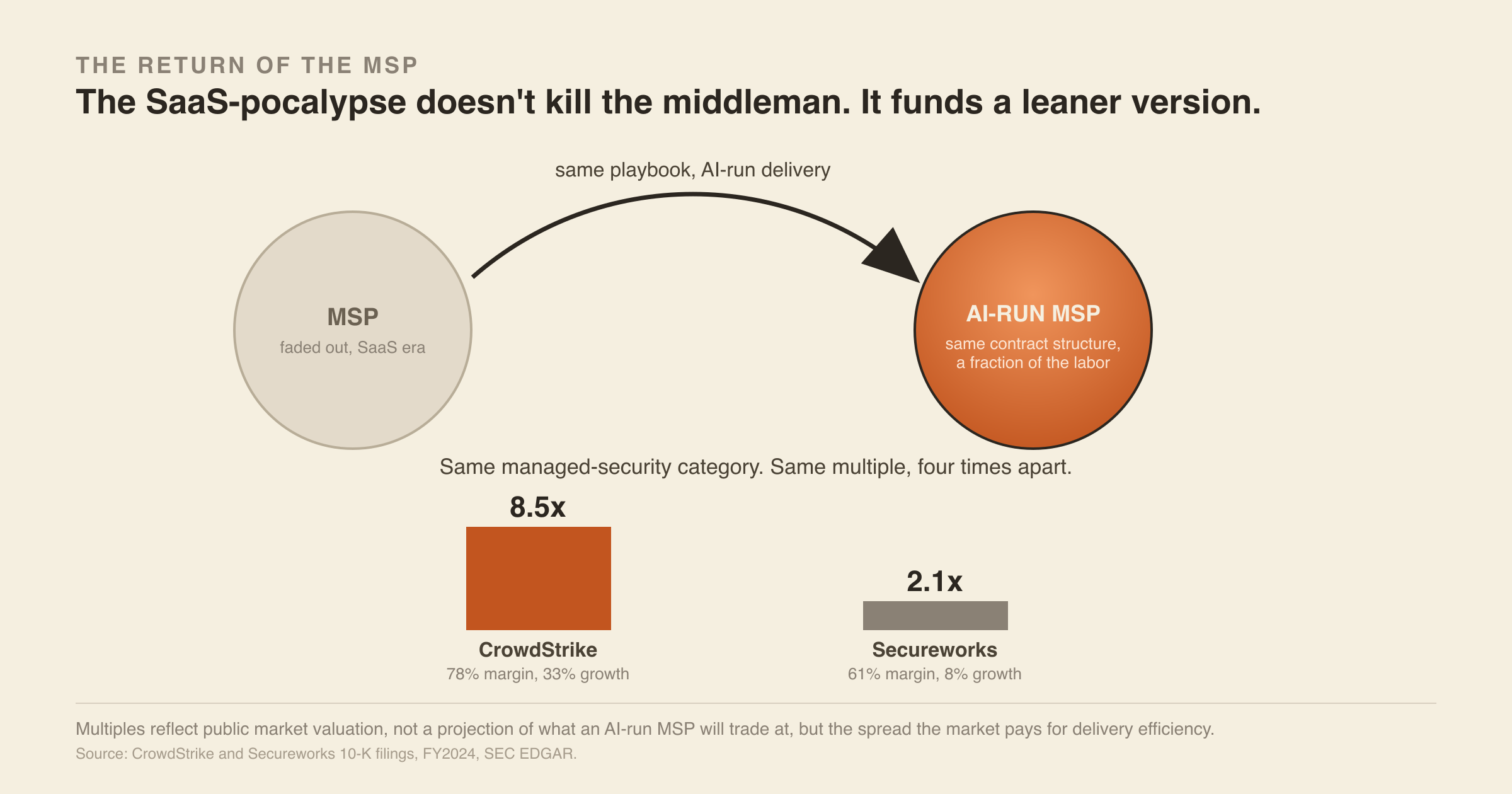
The SaaS-pocalypse doesn’t kill the middleman. It funds a leaner, AI-run version of it.
By The Chiri Team
When your SaaS vendor’s price stops making sense, who do you actually call?
For the last fifteen years the venture answer was: nobody, you just buy more SaaS. Recurring software revenue got the premium multiple, services got the discount, and an entire industry built itself around a simple belief, software scales, people don’t. That belief is why so much capital chased the subscription model instead of the vendor who shows up and does the work.
The managed service provider never actually went away while that was happening. It just got treated as the less interesting half of the market. Now it is the half that AI is rebuilding first.
The playbook is old. It is also proven, at scale, across three markets
Managed services has one repeatable structure across every category it touches: a client externalizes a capability it cannot economically staff in-house, and pays a specialist a premium to deliver it on an ongoing, contracted basis. Three well-documented markets show exactly how that structure prices out.
Managed hosting runs on a pass-through markup. Kaseya’s survey of more than 3,000 MSPs puts the median cloud cost markup at 1.4 to 1.5x, ConnectWise’s own benchmark data lands in the same 1.35 to 1.55x range, and AWS charges 15 to 20 percent on its own Managed Services offering as an enterprise-scale floor. Rackspace, the largest public managed-hosting operator, runs its cloud segment at roughly 1.4x implied markup and a 46.4 percent blended gross margin on $3.26 billion of revenue. (Kaseya, 2024 MSP Benchmark Survey Report; ConnectWise industry benchmark data, 2024; Rackspace Technology 10-K, FY2024, SEC EDGAR)
Managed security is the sharpest version of the same model, because the expertise is genuinely scarce.
- MDR is priced per endpoint: $15-25/mo for CrowdStrike Falcon Complete, $8-20 for Arctic Wolf, $10-20 for Secureworks Taegis.
- A single SOC analyst, amortized across 50 to 150 customers, generates $1.7 to 2.4 million in revenue.
- Net retention is the best in managed services: roughly 120 percent for CrowdStrike, 125 percent for SentinelOne.
(CrowdStrike, SentinelOne, Rapid7, Arctic Wolf, and Secureworks 10-K filings, FY2024, SEC EDGAR)
The multiple spread inside that one category tells you everything about what the market actually pays for: CrowdStrike, at 78 percent gross margin and 33 percent growth, trades at 8.5x revenue. Secureworks, delivering a comparable service at 61 percent margin but 8 percent growth, trades at 2.1x. Same category, four times the multiple, because one of them scaled the delivery and the other didn’t.
Virtual CISO is the closest existing analog to what an AI-run MSP becomes: a fractional senior practitioner on a monthly retainer.
| Client size | Monthly retainer |
|---|---|
| Small business | $4,000 – $10,000 |
| Mid-market | $8,000 – $20,000 |
| Enterprise | $15,000+ |
Contracts run one to three years with 3 to 5 percent annual escalation. Roughly 30 to 50 percent of clients negotiate an additional bundled project into every renewal.
Why AI changes who can afford to run this playbook, not whether it works
Every one of those numbers proves the model works. None of them solve the constraint that has always capped who can run it: a human expert can only be amortized across so many clients before service quality degrades, which sets a floor on how cheap the retainer can get and a ceiling on how small a client can be and still be profitable to serve. That floor is exactly why the vCISO market starts around $4,000 a month, not $400.
An AI-run version of the same playbook does not eliminate the expert. It changes how much of the delivery requires that expert’s direct hours versus an ontology that has already learned the pattern from prior engagements. The account structure stays the same, a rolling multi-year contract, embedded expertise, a bundled project on every renewal. What changes is the labor intensity behind it, and labor intensity is the entire reason the vCISO tier starts where it does and the pure-SaaS tier can’t serve either end of the market well.
White glove is not a nice-to-have in this transition, it is the entire pitch
The reason this matters now, and not five years ago, is that companies are living through exactly the failure mode that makes a managed provider valuable. They funded employee AI tool subscriptions and training, watched the newly-skilled staff become more expensive to retain and more attractive to poach, and still ended up with a sprawl of disconnected tools nobody fully owns. McKinsey’s 2026 State of AI research puts lack of technical AI talent among the top barriers companies cite for failing to scale AI, at 38 percent, behind only leadership vision and organizational readiness. Talent is not the single cause of stalled AI initiatives, but it is a real and commonly cited one, and it is the piece a managed provider is built to solve directly. (McKinsey, “The State of AI,” 2026)
That is the client an MSP-model provider is built to serve, the company that already tried to build it in-house, spent real money doing so, and would now rather rent proven expertise on a contract than rebuild the muscle from scratch. It is a services relationship, priced like one, delivered at a cost structure only AI-run delivery makes possible.
Each seat feels this differently:
- The CFO watches software line items and internal AI tooling spend that never quite converts into measurable output.
- The CHRO watches the retention problem directly, the staff getting expensive to keep the moment they get good.
- The COO owns the sprawl of half-adopted tools nobody fully uses.
- The CEO has to decide whether the answer is another round of hiring and training, or renting proven delivery on a contract while the internal capability catches up on its own timeline.
Where in your operation are you already the client this describes, funding tools and training for a capability you still don’t reliably have in-house?
Sources cited:
- Kaseya, “2024 MSP Benchmark Survey Report.” https://www.kaseya.com/resource/2024-msp-benchmark-survey-report/
- ConnectWise, industry pricing and margin benchmark data, 2024.
- AWS Managed Services, public pricing: management fee structure.
- Rackspace Technology 10-K, FY2024, SEC EDGAR: revenue, gross margin, cloud markup.
- CrowdStrike, SentinelOne, Rapid7, Arctic Wolf, Secureworks 10-K filings, FY2024, SEC EDGAR: MDR pricing, gross margin, growth, EV/revenue, SOC staffing ratios.
- McKinsey, “The State of AI,” 2026, on AI scaling rates and the top-cited barriers to scaling, including technical talent. https://www.mckinsey.com/capabilities/quantumblack/our-insights/the-state-of-ai