
Bespoke software just got as cheap as renting it. That breaks the SaaS and services divide for good.
By The Chiri Team
Why does your team pay for a thousand-dollar-a-month software seat that one person actually uses?
For a decade, the answer was simply that this is how enterprise software works. You buy the license, you staff the implementation, you accept the seat sprawl as the cost of having the tool at all. That trade only made sense because building bespoke software was expensive and slow, and buying a generic platform off the shelf was faster than building your own. AI just broke that trade, and it broke it from both directions at once.
The SaaS side of the binary is compressing
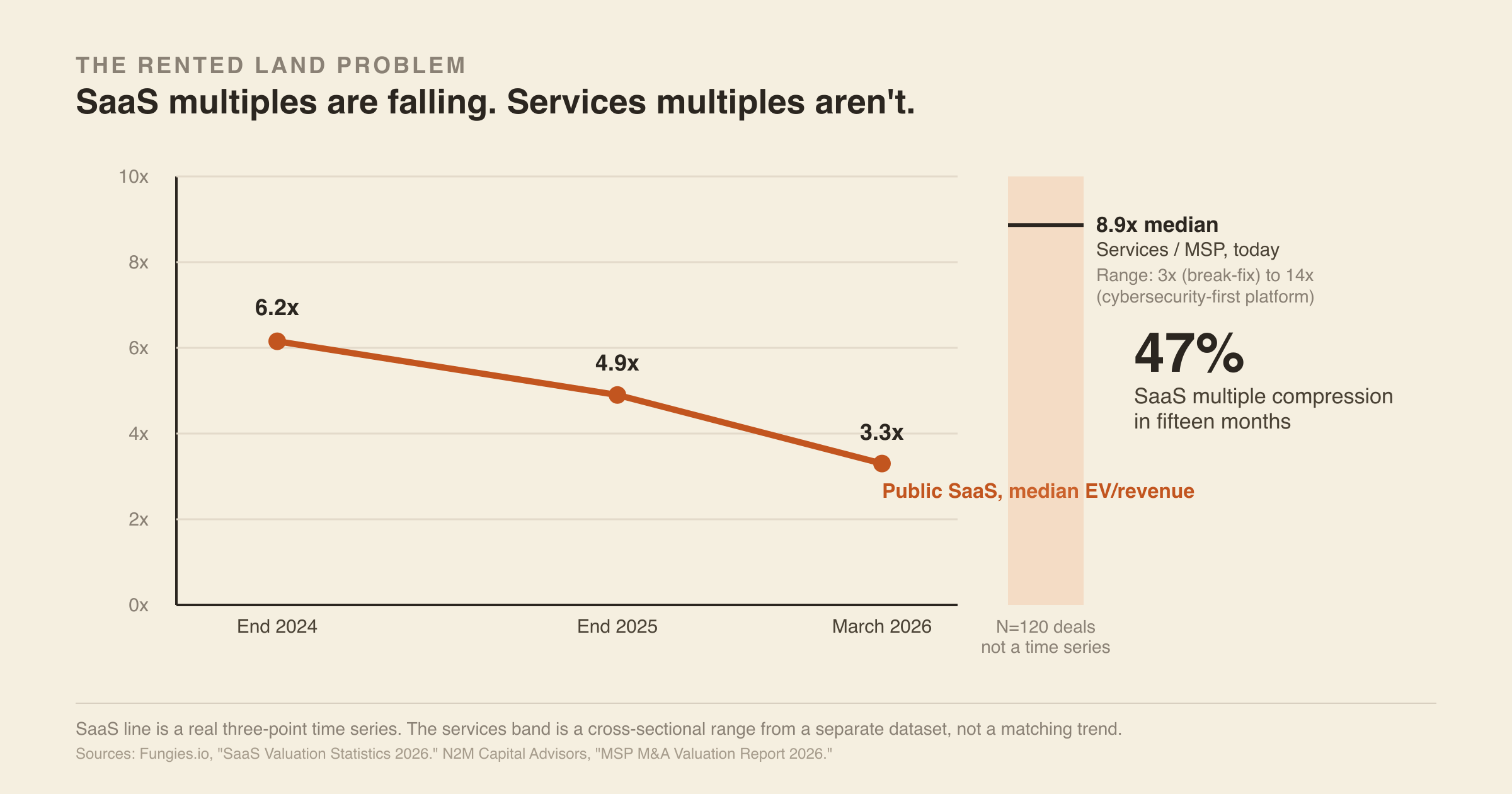
Public SaaS valuations have been sliding for two years running. The median EV to trailing twelve month revenue multiple for public SaaS companies:
- 6.2x at the end of 2024
- 4.9x at the end of 2025
- 3.3x as of the end of March 2026
That is roughly a 47 percent compression in fifteen months, on a sector that spent the 2021 run-up trading closer to 18.6x. (public SaaS multiple compression data, 2026)
Some of that is macro. Interest rates and a broader market recalibration explain part of it. But a meaningful part of it is structural, and it is the part that matters here: generic software sold at scale to as many logos as possible carries feature bloat by design, because it has to serve everyone in a flat way. That bloat is exactly what a small internal team, armed with an AI coding agent, can now route around by building the two or three features they actually use.
You can watch this happen in real time in the market’s reaction to model providers moving downstream. When Anthropic launched a legal plugin for Claude on February 3, 2026, automating contract review, NDA triage, and compliance tracking, Thomson Reuters fell 16 percent that day, RELX fell 14 percent in its steepest single-day drop since 1988, and Wolters Kluwer fell 13 percent. (Morningstar, February 2026) That is not one company’s problem. That is what the market does to a category of point solution the moment it believes the underlying model can do the specific workflow directly.
The services side of the binary is doing the opposite
Services multiples are moving up, and the reason is not complicated. A services business already carries the labor margin structure that a SaaS company spent a decade trying to engineer away. What AI does for a services business is let it deliver at software speed while keeping the labor economics that made it valuable in the first place, bespoke work, high touch, priced for outcomes instead of seats.
The MSP data shows this clearly. Across 120 analyzed MSP transactions, the median EV to EBITDA multiple sits at 8.9x, ranging from 3 to 5x for a break-fix, project-heavy shop up to 10 to 14x for a cybersecurity-first platform and 9 to 13x for a broader AI-enabled platform. (N2M Capital Advisors, “MSP M&A Valuation Report 2026”) The AI-enabled and security-forward services businesses are getting rewarded exactly where generic SaaS is getting punished, on the same underlying capability.
Why the binary itself was always artificial
SaaS versus services was never a law of nature. It was a byproduct of how expensive it used to be to build software. When building custom was slow and buying generic was fast, the market sorted itself into two camps, and a whole industry of investors built return models on the assumption that recurring software revenue would always be worth more than recurring service revenue.
Look at the companies that already sell judgment on a services model and you can see the ceiling and the floor of the old binary in the same breath:
- Palantir: $3.46B revenue, ~78% gross margin, 16 to 18x EV/revenue, a software-grade multiple on what is structurally a forward-deployed-engineer business, 20 to 40 engineers embedded per account, billed near $1M a year each. $1.38M revenue per employee, $4.68M average deal size, because the labor-heavy delivery forces a floor on who can afford it.
- Accenture: the traditional consulting version of the same idea, running on 60 to 70 percent offshore labor arbitrage. $89,000 revenue per employee, a factor of 15 lower than Palantir, and trades at 2.8 to 3.2x revenue.
(Palantir Technologies and Accenture plc FY2025 10-K filings, SEC EDGAR) Same underlying idea, sell externalized expertise on contract, priced almost twenty times apart, because one of them figured out how to make the labor scale and the other didn’t.
The security managed-services market shows the same spread inside a single category:
- CrowdStrike (Falcon Complete): $3.05B revenue, 78% gross margin, growing 33%, trades at 8.5x revenue.
- Secureworks: a comparable managed detection service, $689M revenue, 61% gross margin, but only 8% growth, trades at 2.1x.
(CrowdStrike, SentinelOne, Rapid7, Arctic Wolf, and Secureworks FY2024 10-K filings, SEC EDGAR) A four-times multiple spread, inside the same managed-services category, tracking almost entirely on how much of the delivery is platform versus how much is still headcount. That is the whole thesis in one table.
Salesforce already ran this exact transition once, just slowly. In its earliest years the company was services-heavy, gross margins in the 28 percent range, revenue per customer in the low millions, funding customer acquisition and switching costs the hard way. Over roughly 25 years, as the platform matured and absorbed more of the delivery, gross margin climbed to 75 percent and revenue per customer fell to the $10,000 to $100,000 range, the platform moving down-market as it did more of the work itself. What AI does to that curve is compress it. A services business no longer needs 25 years to earn a platform multiple if the AI layer, not an army of engineers, is what’s doing the learning and the delivery.
That assumption depended on software staying hard to build. It no longer is. A managed service provider that builds bespoke, AI-assisted applications for its clients can now move at close to SaaS development speed while keeping the labor margin, the client relationship, and the pricing power of a services business. That is not a hybrid model bolted together for a pitch deck. It is what happens naturally once the cost of building custom software drops far enough that generic software’s only remaining advantage, speed to deploy, disappears.
The companies caught in the middle are the ones still trying to be a generic platform while their own engineering headcount, and their own infrastructure bill, keep climbing to support features fewer and fewer customers actually use. GitHub’s own reliability numbers are a useful proxy for what that strain looks like at scale. Between May 2025 and April 2026, independent uptime monitoring tracked 257 separate incidents on the platform, 48 of them major outages. (IncidentHub, GitHub reliability tracking, 2025-2026) That is a platform built to serve millions of users straining under the exact microservices complexity that made it generic in the first place.
The binary is not becoming irrelevant because software is going away. It is becoming irrelevant because the cost curve that created it is gone.
This shows up differently depending on where you sit:
- The CFO is the one watching software line items that used to be untouchable start to look negotiable.
- The CEO is the one deciding whether the company’s own product roadmap is still worth defending as pure SaaS or should absorb more services-style delivery.
- The COO inherits whichever seats and workflows quietly stop getting used, long before finance notices the waste.
- The CTO is the one who has to be honest about whether the platform is still earning its complexity or just carrying it.
Where in your stack are you still paying SaaS prices for what has quietly become a services problem?
Sources cited:
- Fungies.io, “SaaS Valuation Statistics 2026,” public SaaS multiple compression (6.2x to 4.9x to 3.3x). https://fungies.io/saas-valuation-statistics-2026/
- Morningstar, “Thomson Reuters, RELX, and Wolters Stocks Crushed After Anthropic Debuts Claude Legal Plug-In,” February 2026. https://www.morningstar.com/stocks/reuters-relx-wolters-stocks-crushed-after-anthropic-debuts-claude-legal-plug-in
- N2M Capital Advisors, “MSP M&A Valuation Report 2026.” https://n2mcap.com/msp-ma-valuation-report-2026/
- IncidentHub, “GitHub Outages 2025-2026: Reliability Analysis and Outage History.” https://blog.incidenthub.cloud/github-reliability-outage-history-2025-2026
- Palantir Technologies 10-K, FY2025, SEC EDGAR: revenue, gross margin, EV/revenue, revenue per employee, average ACV.
- Accenture plc 10-K, FY2025, SEC EDGAR: revenue, revenue per employee, EV/revenue.
- CrowdStrike, SentinelOne, Rapid7, Arctic Wolf, Secureworks 10-K filings, FY2024, SEC EDGAR: managed security services revenue, gross margin, growth, EV/revenue.
- Salesforce historical financials, gross margin and revenue-per-customer trend, 1999-2025 (public filings).