
Every AI vendor conversation bounces between the same two questions. Here’s our actual answer to both.
By The Chiri Team
Are you going to come in and tell us to cut our headcount?
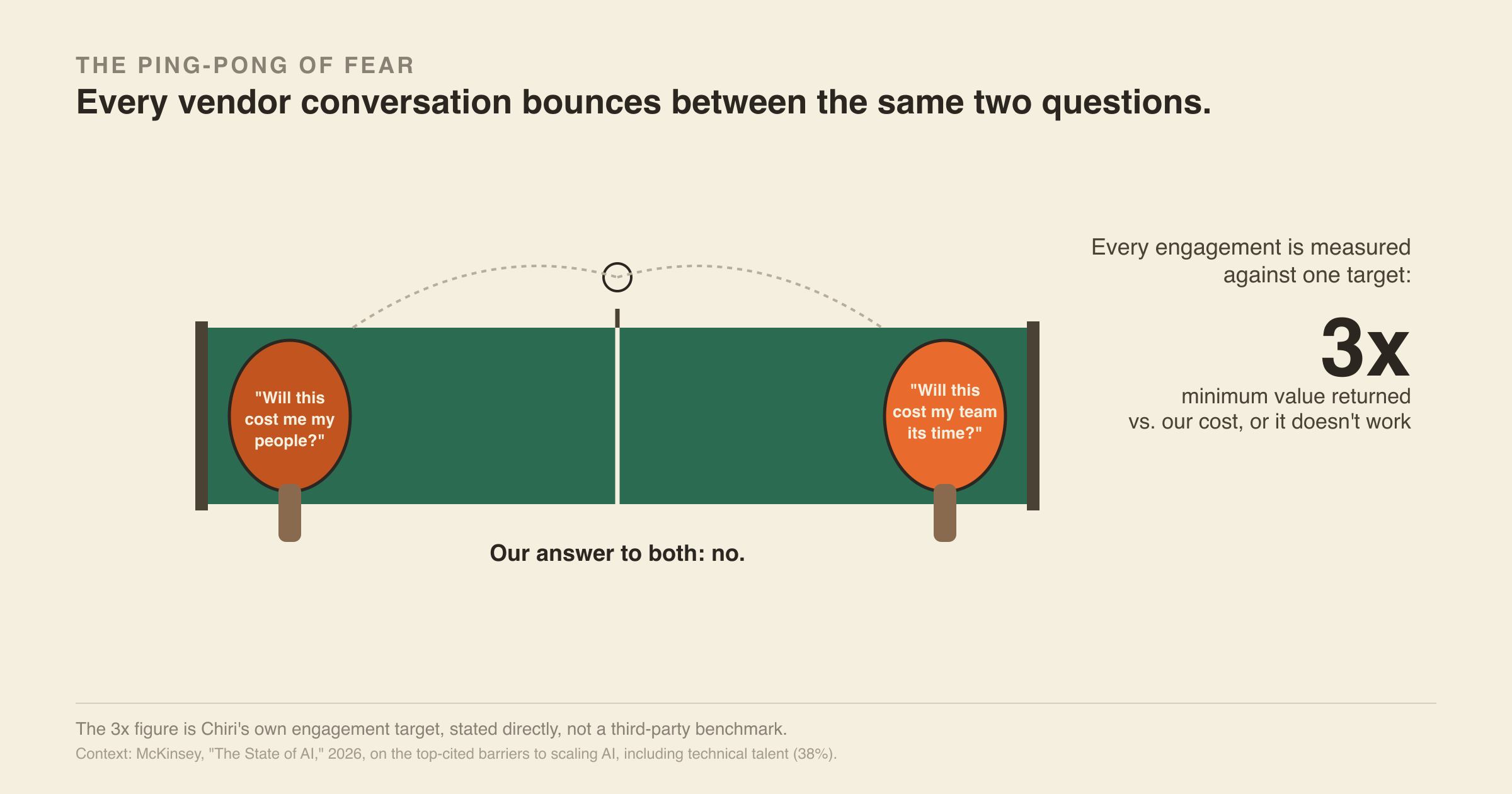
That is the first question in almost every conversation we have with a prospective client. The second one lands right after it: are you going to make my team learn a whole new tool? Back and forth, every time, like a rally that never ends, because the two fears are really one fear wearing two outfits: will this cost me my people, and will this cost my people their time.
The honest answer to both is no. Here is why, in specific terms rather than a reassurance.
No, we are not going to recommend cutting your headcount
We do not get paid to make your organization smaller. We get paid to make your existing people capable of more, and those are not the same business model wearing different marketing.
Every business exists to generate revenue. Most businesses also carry a category of work everyone agrees is a drag, the manual, repetitive, low-judgment tasks that eat hours without moving the number that matters. The first thing we target is that category, not your people. The second thing we target is the opposite end of the spectrum, expanding what your current staff are capable of doing on the work that actually grows the business. Neither of those requires fewer people. Both require the same people spending their time differently.
The market data backs up why this matters more than it might sound. McKinsey’s 2026 State of AI research finds nearly two-thirds of enterprises have not yet begun scaling AI beyond pilots, and lack of technical AI talent is among the top-cited barriers, at 38 percent, right behind a lack of leadership vision and organizational readiness. (McKinsey, “The State of AI,” 2026)
Cutting the people who understand your business to fund an AI initiative that a majority of enterprises are still struggling to scale is not a strategy. It is a bet against your own odds.
No, we are not going to make your team learn a new tool
The market narrative right now says everyone is becoming a builder. We think that narrative is wrong for most roles, and saying so costs us nothing because it is true. Some people are builders by function and temperament. Most people were hired to be excellent at something else, running operations, managing accounts, closing deals, and asking them to also become part-time software engineers is not an upgrade, it is a second, unpaid job layered on top of the one they already do well.
The alternative is not “no AI.” It is pairing a forward-deployed operator, someone who understands your business process, with an engineer who understands the platform, so the tool gets built around how your team already works instead of asking your team to reshape itself around the tool. Your subject matter expert stays the subject matter expert. The complexity gets absorbed on our side, not handed to your staff as new homework.
Why the answer to both has to be the same answer
These are not two separate promises we are making to be agreeable. They come from one underlying design choice: the value we generate has to outweigh the cost of us being there, by a real multiple, not a marketing one. Every engagement is measured against the daily cost of having us on board, and the target is a minimum of three times that cost returned as value to your business.
That number does not work if we are eliminating the people who understand your business, and it does not work if your team is spending its time learning our tool instead of doing its job. Both of the answers people are afraid of would actively work against the thing we are being paid to deliver.
Which one of those two fears has been the real blocker in your own AI conversations, and has anyone actually answered it for you in specific terms instead of a slogan?
Sources cited:
- McKinsey, “The State of AI,” 2026, on AI scaling rates and the top-cited barriers to scaling, including technical talent. https://www.mckinsey.com/capabilities/quantumblack/our-insights/the-state-of-ai