Non-domestic models are near-frontier at three percent of the price. Adoption still lags, and it’s not about capability.
By The Chiri Team
If a model costs three percent of what you are paying today and gets you ninety-six percent of the capability, why would you still be paying full price?
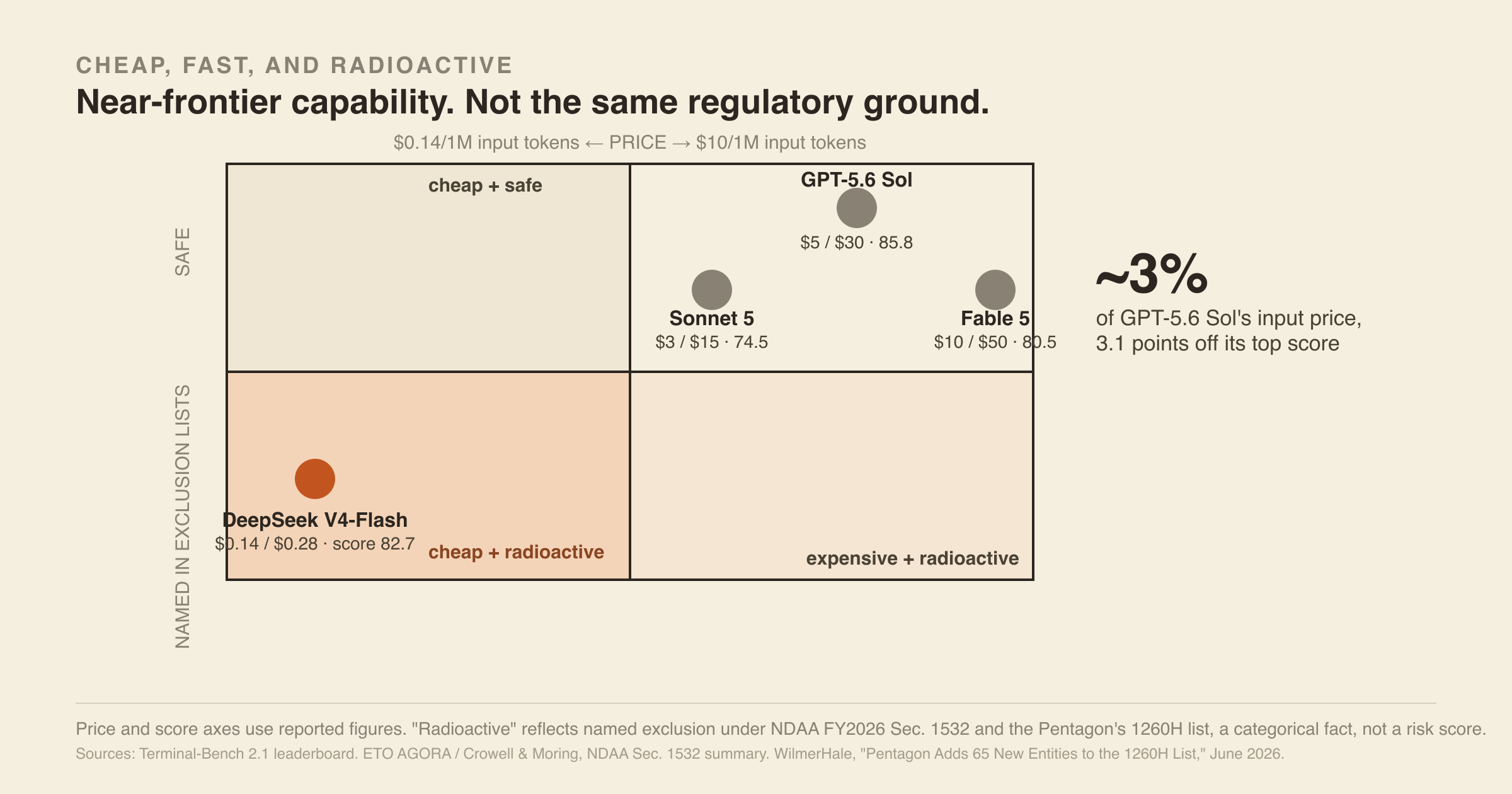
That is not a hypothetical. On the most recent Terminal-Bench 2.1 leaderboard:
| Model | Score | Price (input / output per 1M tokens) |
|---|---|---|
| GPT-5.6 Sol | 85.8 | $5 / $30 |
| Fable 5 | 80.5 | $10 / $50 |
| DeepSeek V4-Flash | 82.7 | $0.14 / $0.28 |
| Sonnet 5 | 74.5 | $3 / $15 |
A real gap, not parity. DeepSeek is not the best model on the board. It is within striking distance of the best model on the board, at roughly three percent of the price. That distinction matters, because it changes who adopts it and for what, not whether anyone does.
And the honest answer to who is adopting it is: a lot of companies, quietly, and the number depends entirely on what you count.
The adoption number is really three different numbers
Look at token volume on developer-facing platforms and the shift looks dramatic. CNBC’s July 2026 investigation found Chinese-origin models accounted for at least 30 percent of enterprise token volume on OpenRouter every week since February 8, spiking to 46 percent in a single week, up from an average of just 11 percent over the prior twelve months. (CNBC) By late July, that had climbed further, with Chinese models taking 57 percent of the tokens US firms consumed on OpenRouter in one week, and all five of the marketplace’s top models being Chinese at one point mid-month. (the-decoder)
Look at Vercel’s production gateway and the picture sharpens in an important way. Open-weight models ran 29 percent of all gateway tokens in June 2026, up from 11 percent in April, but represented under 4 percent of total spend. DeepSeek alone took 22.6 percent of token volume, third place behind Anthropic and Google. (Vercel)
Tokens are not dollars. Cheap models get pointed at cheap, high-volume work. Anthropic, by contrast, captured 61 percent of gateway spending on 32 percent of tokens, concentrated in coding, back-office automation, and app generation, the workloads where teams still prioritize accuracy over cost.
Look at corporate spending data instead of developer traffic, and the number nearly disappears. Ramp’s AI Index put DeepSeek’s adoption among US businesses at roughly 0.1 percent in April 2026. By June, direct payments to DeepSeek, not self-hosting the open-weight model, but paying DeepSeek’s own service directly, had pushed it to the top of Ramp’s trending vendor list, driven largely by a permanent 75 percent discount on its V4-Pro model made permanent that May. (Ramp AI Index via the-decoder)
Three real numbers, three different things being measured:
- 30 to 57 percent of developer token traffic.
- 29 percent of gateway volume on 4 percent of spend.
- 0.1 percent of corporate procurement, trending sharply upward off a very small base.
None of them are wrong. They are measuring different things.
Named adopters, and why they are the exception, not the rule
The companies moving fastest are not hiding it. Coinbase CEO Brian Armstrong disclosed switching the company’s default models to Zhipu’s GLM 5.2 and Moonshot’s Kimi 2.7, defaulting every engineer to the open-weight models through an internal gateway and reserving frontier models for tasks that genuinely need them, cutting internal AI spend by roughly half even as token consumption hit record highs. (MLQ News)
Cursor built its Composer 2 coding model on a Kimi foundation. Lindy, Airbnb, and Uber are named among the companies routing meaningful work to non-domestic models. (the-decoder)
These are sophisticated technical organizations with the engineering depth to build their own routing infrastructure and evaluate the risk themselves. That is precisely why they are early rather than typical. Most operationally complex mid-market companies do not have an internal LLM gateway team, and the calculus looks different for a healthcare group or a logistics company than it does for Coinbase.
The real ceiling on adoption is not capability. It is regulatory clock speed
This is the part that keeps mid-market executives cautious, and it is a rational caution, not fear for its own sake. The FY2026 NDAA’s Section 1532 requires the Department of Defense to exclude AI developed by DeepSeek and affiliated entities from its systems and prohibits contractors from using it on DoD contracts, with only narrow waivers available. (ETO AGORA / Crowell & Moring)
In June 2026, the Pentagon added 65 new entities to its Section 1260H list of Chinese military-linked companies, bringing the total to 188 and including Alibaba and Baidu for the first time. Listed companies face a bar on direct DoD contracting starting that month, and a bar on indirect procurement of their products or services beginning in June 2027. Alibaba is suing to challenge the designation. (WilmerHale, CNBC) House committees have opened inquiries into Coinbase’s and Cursor’s use of Chinese-developed models.
None of that makes it illegal for a private company outside the defense supply chain to use a non-domestic model today. It does mean the regulatory ground is shifting under this decision faster than most procurement processes are built to track, and a company that adopts without a real threat model, and without understanding whether it touches a defense contract, a federal customer, or an entity on an expanding restricted list, is making a bet on where that line lands next year.
That bet is exactly what part of the domestic industry is now lobbying against restricting further, and the split is not subtle. On July 24, 2026, Nvidia, Microsoft, Meta, Palantir, and roughly twenty other companies launched an open letter, “Open Weights and American AI Leadership,” urging Washington to avoid premature, sweeping restrictions on open-weight models. It grew to more than 230 signatories within a week, including OpenAI. Amazon and Anthropic have not signed. (“Open Weights and American AI Leadership,” full text hosted by Microsoft)
Jensen Huang used his first-ever post on X to share it:
“AI will transform every industry, power every company, and be built by every country. Open models strengthen safety and cybersecurity, accelerate innovation and diffusion, and enable sovereignty. The world needs both frontier closed models and frontier open models.”
Satya Nadella posted a similar message nine minutes later. Elon Musk replied, “Jensen is right. This has my full support.” Mark Zuckerberg quote-posted his agreement the same day, then wrote an op-ed in the Wall Street Journal making the same case. (Mike Isaac, “The Fight Tearing Apart Silicon Valley,” The New York Times’ The Daily, July 31, 2026)
OpenAI and Anthropic argue the opposite: that open-weight models handed to any actor, including a government, are a genuine safety risk, and they have real incidents to point to in making that case. Read the lineup on each side carefully. This is not a settled argument between an obviously safe path and an obviously risky one. It is a live fight among the people who built this technology, over what the risk actually is, playing out in real time in front of the regulators who will decide where your compliance obligations land next year.
The actual decision, stripped of the noise
The realistic comparison for most buyers today is not the frontier leader against the cheapest option. It is DeepSeek’s 82.7 against Fable 5’s 80.5 and Sonnet 5’s 74.5, a real capability spread among models that are all commercially available, weighed against price, data residency, and a regulatory environment that is still being written in real time.
That is a genuine tradeoff, not a slam dunk in either direction, which is exactly why low penetration and high cost efficiency are both true at the same time.
Each seat in the room is weighing a different side of that tradeoff:
- The CFO sees the three percent price tag and a budget line that could shrink dramatically.
- The CTO sees a regulatory list that adds entities monthly and a routing decision that has to be defensible a year from now, not just cheap today.
- The COO owns what breaks if a model gets restricted mid-contract and a workflow has to move overnight.
- The CEO owns the choice of whether to be early, like Coinbase, or prudent, and has to be honest about which one the company can actually execute well.
Where does your own threat model actually sit on that tradeoff, and has anyone in your organization written it down?
Sources cited:
- CNBC, “Chinese AI models are gaining ground with U.S. companies as OpenAI, Anthropic costs surge,” July 7, 2026. https://www.cnbc.com/2026/07/07/chinese-ai-models-costs-us-openai-anthropic.html
- the-decoder, “Coinbase joins the rush to Chinese AI models as Western labs face a pricing stress test,” 2026. https://the-decoder.com/coinbase-joins-the-rush-to-chinese-ai-models-as-western-labs-face-a-pricing-stress-test/
- Vercel, AI Gateway Production Index, July 2026. https://vercel.com/blog/ai-gateway-production-index-july-2026
- the-decoder, “DeepSeek topped Ramp’s trending software vendors in June 2026,” citing Ramp AI Index. https://the-decoder.com/deepseek-topped-ramps-trending-software-vendors-in-june-2026-as-us-companies-chase-cheaper-ai/
- MLQ News, “Coinbase Switches to Chinese AI Models GLM and Kimi, Cuts AI Spending by 50%.” https://mlq.ai/news/coinbase-switches-to-chinese-ai-models-glm-and-kimi-cuts-ai-spending-by-50/
- ETO AGORA / Crowell & Moring, FY2026 NDAA Section 1532 summary. https://agora.eto.tech/instrument/2694
- WilmerHale, “Pentagon Adds 65 New Entities to the 1260H List,” June 2026. https://www.wilmerhale.com/en/insights/client-alerts/20260611-pentagon-adds-65-new-entities-to-the-1260h-list-of-chinese-military-companies
- CNBC, “Pentagon expands list of China military-linked firms to include Alibaba, Baidu,” June 9, 2026. https://www.cnbc.com/2026/06/09/alibaba-baidu-byd-named-on-pentagons-china-military-list-.html
- “Open Weights and American AI Leadership,” open letter, full text hosted by Microsoft, launched July 24, 2026. https://www.microsoft.com/en-us/corporate-responsibility/topics/open-weight/
- Mike Isaac, “The Fight Tearing Apart Silicon Valley,” The New York Times’ The Daily, July 31, 2026 (transcript). https://www.nytimes.com/2026/07/31/podcasts/the-daily/ai-open-source-china-silicon-valley.html
Note on the benchmark chart: the Terminal-Bench 2.1 scores above reflect the chart supplied for this piece. DeepSeek V4-Flash trails the top-scoring model by 3.1 points; it is not the leader. The story is price efficiency at near-frontier capability, not category-leading capability.