By The Chiri Team
A word that used to belong to a narrow slice of AI infrastructure conversations just showed up in a major enterprise software announcement. On August 26, 2026, Salesforce and Anthropic announced Claudeforce. Salesforce’s own release describes its contribution to the deal in one specific phrase: a “trusted enterprise harness,” built to make “data, workflows, business logic, actions, and governance securely accessible for agentic experiences.”
That is not marketing filler. It is a specific technical claim, and it signals something buyers evaluating any AI platform should understand now, not later. The model is no longer the part of the stack companies are fighting over. The harness around it is.
What a harness actually is
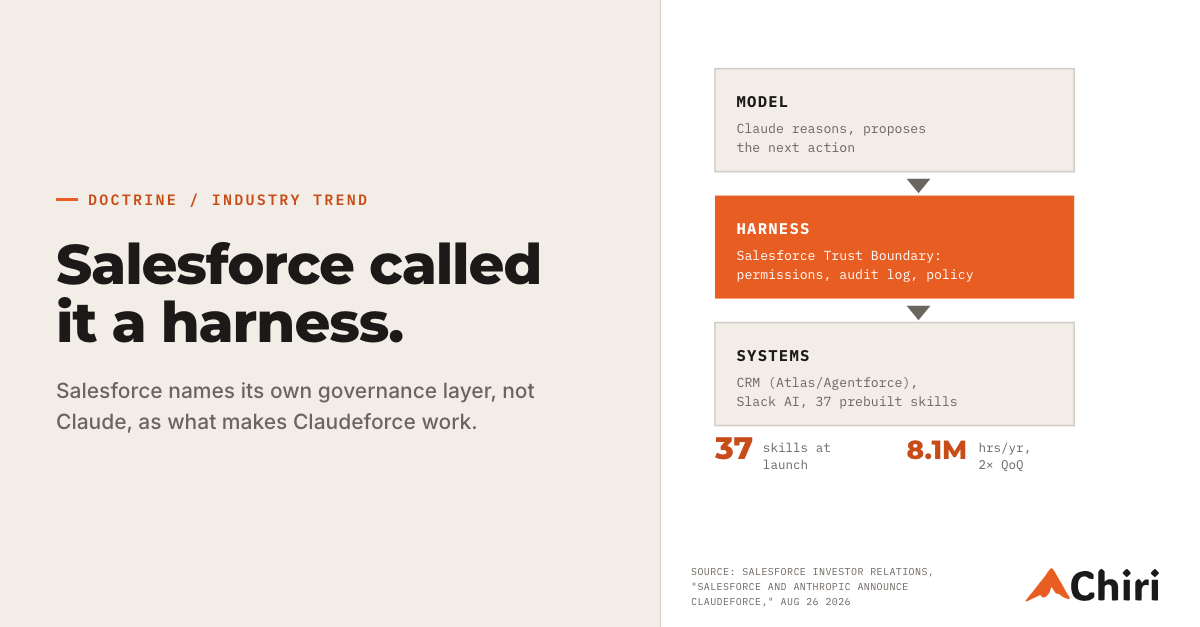
A harness is the layer that sits between a model and the real systems a company runs on. The model reasons and proposes an action. The harness decides what that action is allowed to touch, logs what happened, and enforces the rules a business actually needs: which data an agent can see, which workflows it can trigger, which approvals a human still has to give.
Without a harness, a capable model is still just a capable model. It has no permissions structure, no audit trail, and no way to prove after the fact what it did and why. A harness is what turns a model into something a company can actually run in production, on real data, without flying blind.
The term is showing up everywhere right now because the underlying shift is real. Frontier models have gotten commoditized fast. Any company with the budget can license a strong model today. What separates a working AI deployment from a risky one is no longer which model is doing the reasoning. It is the layer of governance, permissions, and accountability wrapped around it.
The clearest evidence yet: Claudeforce
Claudeforce puts Anthropic’s Claude models inside Salesforce’s product stack in three specific ways, according to the Salesforce Investor Relations release.
Claude becomes the reasoning model for Salesforce’s Atlas Reasoning Engine, which powers Agentforce decisions across the platform. It decides what an agent does next, not just what an agent says. Claude also becomes the default model inside Slack, running every workspace on Slack AI without a mix of vendors chosen case by case.
The release ships with 37 prebuilt sales skills at launch, each a packaged action a Salesforce agent can call without custom engineering: a lead qualification step, a pipeline update, a follow-up scheduling task. A company does not have to build these from scratch. It gets an agent working inside its CRM from day one.
The technical delivery matters as much as the feature list. Claude runs through Amazon Bedrock, inside what Salesforce calls the “Salesforce Trust Boundary.” Salesforce is not just plugging in a third-party model. It is wrapping that model in permissions, logging, and policy that belong to Salesforce.
The release reports 8.1 million hours of annualized productivity gains from Slackbot, up 2x quarter over quarter, describing what the current Slack AI assistant already returns ahead of the wider Claudeforce rollout. Open beta for Claudeforce is expected in September 2026.
Why a company the size of Salesforce reaches for this word
Salesforce could have framed this deal any number of ways. It could have positioned Agentforce as the product and Claude as a component inside it. Instead, the release frames Salesforce’s own layer as the thing that makes data, workflows, and governance secure and accessible. That is a description of a harness.
A company that size is telling its own investors something specific. The model is not where the defensible value sits. Salesforce spent two decades building the CRM of record for a large share of the enterprise market. It is now telling investors that the return on that work is the layer wrapped around a third-party model, not a model it built itself.
The 37 prebuilt skills reinforce the same point. A skill is not a model capability by itself. It is a packaged, governed action inside a specific workflow. Salesforce is not selling access to Claude on its own. It is selling the skills, the trust boundary, and the workflow logic that make Claude usable inside a real account. The 8.1 million hours figure follows the same pattern: that return came from a model wired into a specific tool with specific permissions and specific data already in place, not from a smarter model in isolation.
What to check before you believe any harness claim
The word “boundary” in Salesforce’s own naming points at the thing every buyer should check before taking a harness claim at face value. A harness governs the boundary it was built for. It does not govern anything outside that boundary, and a company evaluating one should ask exactly where that line sits.
Salesforce’s boundary covers a company’s CRM and, with this release, its Slack workspace. A company running its sales motion, support motion, and internal messages inside that stack gets real coverage across most of what it does day to day.
Most operationally complex companies do not look like that. A mid-market company rarely has one system of record. It has several systems, bought at different times, from different vendors, each with its own owner and its own idea of what counts as current data. Consider a mid-market staffing firm running an applicant tracking system, a separate payroll system, a vendor management system, a scheduling tool, and a set of spreadsheets maintained by hand. No single vendor’s trust boundary covers all five. A placement confirmed in the VMS should trigger a scheduling entry, which should trigger payroll setup, which should update the ATS record. Each handoff crosses a boundary that no single vendor built with the next step in mind.
That gap is not a knock on any one vendor’s harness. It is a structural fact about most companies’ technology stacks. A harness built for one system, however well built, was never going to reach past the boundary it was designed for.
Three questions worth asking about any harness claim
Where does the boundary actually stop? A harness claim usually covers one system, one platform, or one vendor’s stack. Ask directly what falls outside that coverage, not just what falls inside it.
Who owns the seams between systems? Most real operational failures happen in the handoff between two systems, where one record does not match another and no one is watching the gap. A harness that covers each system well can still leave the connective tissue between them unowned.
Does the harness produce a record you can actually audit? A harness worth trusting should be able to show, after the fact, what an agent touched and why it was allowed to. If a vendor cannot produce that record on request, the governance claim is a description, not a mechanism.
The pattern behind the term
Claudeforce is one visible instance of a broader shift already underway. Frontier models are becoming available to any company willing to license one. Once that happens, the model stops being the differentiator between competitors in a category. Value moves to the layer that connects a model to a company’s real systems, real data, and real approval chains.
That shift re-rates two things at once. The standalone software product gets re-rated down, since its intelligence increasingly comes from a licensed model rather than years of proprietary investment. The connective and governance layer gets re-rated up, because that layer is what makes an agent safe enough to act inside a real company and accountable when something goes wrong.
The word “harness” is spreading because the shift it describes is real, not because it is a trend to repeat without substance behind it. The companies worth paying attention to are the ones that can show what their harness actually covers, and just as importantly, what it does not.
This lands differently depending on where you sit
A CEO or COO evaluating any AI platform. Ask what “harness” or “governance layer” means in concrete terms for the vendor in front of you. A real answer names specific systems, specific permissions, and a specific audit record. A vague answer is a marketing word borrowed from a real trend.
A CIO or Head of IT running a multi-vendor stack. A harness that covers one platform well is a real asset. It is not a substitute for governance across the systems that platform does not touch. Map where the coverage stops before assuming it is comprehensive.
A RevOps or Ops leader running cross-system processes by hand. The productivity numbers coming out of well-governed single-platform deployments are real and worth taking seriously. The same category of return is available for the parts of the business no single platform touches, if something is built to govern those seams.
Anyone buying into the term for the first time. “Harness” is not a feature name or a product tier. It describes a real architectural requirement: permissions, logging, and accountability wrapped around a model before it touches anything that matters. Evaluate any vendor’s claim to one against that definition, not against the word alone.
Now that the term is everywhere, what does it actually cover in the tools already running inside your company?