By The Chiri Team
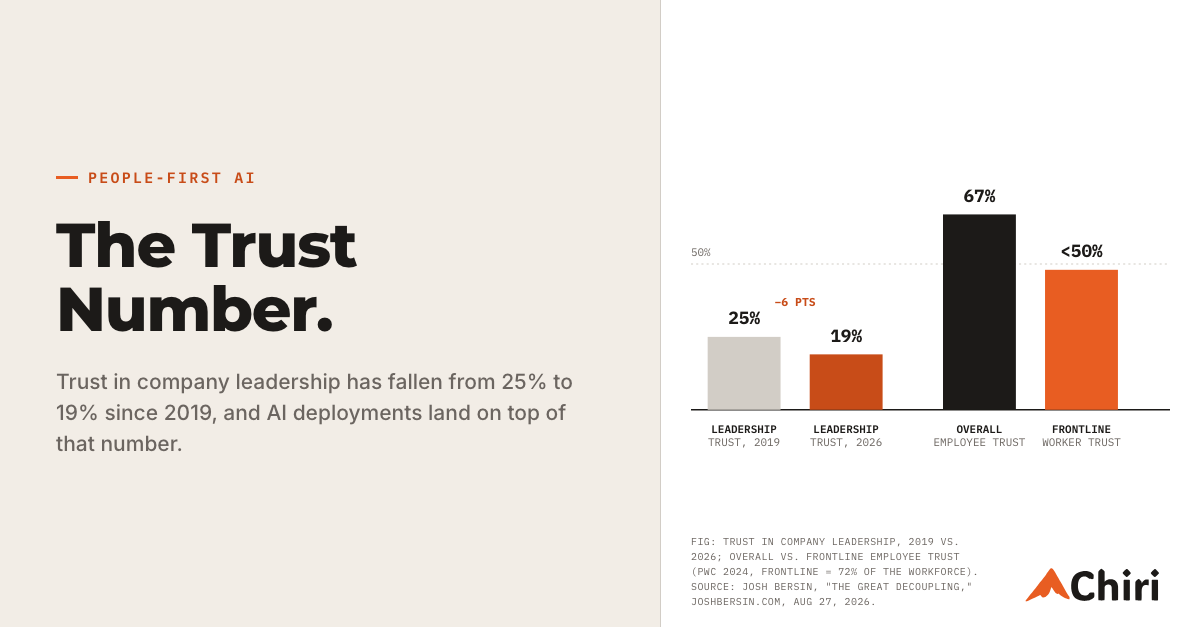
Trust in company leadership sits at about 19%. In 2019 it was 25%. The number has fallen for years, and it keeps falling. Every conversation about AI in the workplace happens on top of that number, not next to it.
HR analyst Josh Bersin laid out the mechanism behind that drop in “The Great Decoupling,” published August 27, 2026. His argument is not that AI created worker distrust. His argument is that decades of policy choices already separated workers from employers, and that AI will speed up a trend that started long before generative models existed.
That distinction matters for anyone deploying AI into a workforce today. The technology is not walking into a trusting relationship and testing it. It is walking into a relationship that has been eroding for three decades, in full view of the people living inside it.
The decoupling Bersin describes
Bersin’s piece traces a set of choices that companies made over the past 40 years. Layoffs became a routine cost lever instead of a last resort. Tenure got shorter, for both companies and workers. Benefits and loyalty structures that once bound people to employers thinned out.
The numbers in the piece are specific. Trust in company leadership dropped from 25% in 2019 to about 19% today. Bersin cites 2024 research from PwC within his August 2026 piece: 67% of employees trust their employers overall, and for frontline workers, who make up 72% of the workforce, trust falls below half. That PwC figure is not new 2026 research. It is a 2024 finding that Bersin brings into his current argument.
The rest of the picture backs up the trend. More than 65% of workers now carry a side hustle, a hedge against relying on one employer for income. The average US worker will be laid off 2.5 times over a career, more than double the rate from three decades ago. Company tenure on the S&P 500 averaged 12 to 13 years in the 1970s and 1980s. Today it is closer to 4 to 5 years.
None of these are AI statistics. They describe a labor market that had already loosened its grip on the worker-employer bond before AI became a workplace topic. Bersin’s contribution is the claim that AI will not slow this decoupling down. Deployed the way most companies deploy new technology, it will speed it up.
AI arrives on top of that number
A worker who has already been laid off more than once, who already carries a side hustle, and who already distrusts leadership does not experience an AI rollout as a neutral event. The rollout lands on a person who has learned, through direct experience, that institutional promises do not always hold.
This is the part of the AI conversation that gets skipped most often. Companies debate model selection, integration timelines, and ROI projections. They spend far less time on how an AI deployment reads to the person whose job touches it every day, especially when that person was never consulted about it.
Bersin’s framing suggests that AI does not introduce a new kind of risk to the employer-employee relationship. It amplifies an existing one. A deployment that arrives without explanation, without visibility into what it does, and without a channel for the affected worker to see or question its actions, confirms what the trust numbers already show. The company decided something about the work, and the worker found out after the fact.
Where the exposure concentrates
The frontline trust figure in Bersin’s piece, under 50%, is not evenly distributed by coincidence. Frontline work concentrates in healthcare, staffing, logistics, and field service, the same sectors where operational AI deployment is accelerating fastest. These are also the sectors where the people closest to the work hold the least institutional trust and the most direct exposure to being automated around.
These same workers hold something the deployment depends on: the real knowledge of how the process actually works. A scheduling system, a dispatch workflow, or a claims process runs the way it runs because of exceptions, workarounds, and judgment calls that live in the heads of the people doing the work, not in a process diagram. Any AI agent that touches that process depends on getting that knowledge right.
An organization that automates around those workers, instead of with them, discards the one asset it most needs and confirms the worker’s worst assumption about how the decision got made. The two failures compound each other. The technical deployment gets worse because it skipped the people who understood the process, and the trust deployment gets worse because those same people watched it happen without them.
The record as a trust instrument
Chiri’s people-first orientation started from watching what organizations do wrong when they handle operational change without the people it touches. An AI agent that acts on a company’s systems and leaves no visible trace of what it did asks workers to trust it on faith, in a labor market where faith in institutions is already running out.
An agent that leaves an inspectable record does something different. It shows what it touched, what it was allowed to touch, and what it changed. A frontline worker whose scheduling, dispatch, or intake process now runs partly through an agent can look at that record and see the boundary of its authority directly.
That visibility changes what the deployment communicates. An agent without a visible record asks a worker to take the company’s word for what happened. An agent with one gives the worker a way to check. The difference is the gap between being told a company respects a worker’s judgment and being shown, in a form the worker can inspect without asking permission.
Chiri treats this record as more than a compliance feature added after the fact. It is the mechanism that lets a company’s claims about respecting its workers be checked instead of taken on faith. An agent’s authority should be visible to the person it affects, not only to the engineer who configured it. That visibility is what lets workers hold a company to its stated commitments.
Doctrine 5: human-first
Chiri’s operating principle for this is doctrine 5: human-first. The principle does not treat visibility as a courtesy layered on top of an automation project. It treats visibility as the mechanism that determines whether the automation project earns any trust at all.
This is a stricter standard than most AI deployments are held to. It is also the standard that Bersin’s numbers argue for. A workforce with 19% trust in leadership, more than 65% carrying a side income, and an average of 2.5 layoffs per career is not a workforce that will extend AI systems the benefit of the doubt. It has already learned, through repeated experience, not to.
An inspectable record does not reverse three decades of policy choices on its own. It does one specific thing: it lets the people affected by an agent’s actions see what that agent did, on the same terms the company itself sees it. In a labor market this exposed, that record is one of the few concrete signals a company can give that it meant what it said.
This lands differently depending on where you sit
HR and people leaders. Bersin’s trust numbers are the baseline any AI rollout communication has to reckon with. An announcement that promises the technology will help workers, without a way for workers to check that claim, adds to the distrust it is trying to address.
Frontline operations leaders in healthcare, staffing, logistics, and field service. The workers closest to the process hold the operational knowledge any deployment depends on, and they carry the lowest trust numbers in the workforce. Excluding them from visibility into the deployment costs the project twice.
IT and security leaders. An inspectable record built for audit and governance purposes doubles as the artifact that gives frontline workers a way to verify an agent’s actions. The same log serves both functions without extra engineering.
Executive teams. The tenure and layoff numbers in Bersin’s piece describe an employer-employee relationship that has already been renegotiated by circumstance. An AI deployment that arrives without transparency does not introduce that renegotiation. It confirms the terms workers already assume are in effect.
What would change if every AI agent deployed inside a company had to leave a record its most affected worker could actually read?