By The Chiri Team
Is the SaaSpocalypse over, or did the money simply move?
HR analyst Josh Bersin says the SaaSpocalypse is over. In an August 27, 2026 podcast and post, he argues that the incumbent HR and enterprise software vendors are not being replaced by AI. They are absorbing it. Workday, Oracle, ADP, SAP, HiBob, Docebo, and Cornerstone all ship AI features inside their existing platforms, and Bersin treats that as proof the displacement story failed.
He is right about the incumbents. None of the seven named vendors above is being dislodged from its seat. But the survival of the seat is not the same claim as the survival of the value that used to sit inside it. The seat stayed. The value that made the seat worth fighting for went somewhere else.
What Bersin actually argues
Bersin’s post makes one claim and does not attempt a second. The named vendors have added AI capability to their existing products, and customers have not abandoned those products for AI-native replacements. The “SaaSpocalypse,” the idea that a wave of AI-native challengers would strip incumbents of their seats, has not happened at the scale predicted.
Josh Bersin
The post carries no numbers. It does not measure market share shift, revenue growth, or valuation. It is a qualitative read of vendor behavior and customer retention, and on that narrow claim it holds up. Enterprise buyers are not ripping out Workday for a startup.
That is a fact about who keeps the login. It is not a fact about where the profit pool sits.
Incumbents absorbing AI is not the whole picture
A vendor can add an AI feature to defend its seat without capturing new economic value from doing so. Feature parity keeps customers from leaving. It does not, by itself, create a new source of margin or growth. Most of what Workday, Oracle, ADP, SAP, HiBob, Docebo, and Cornerstone have shipped reads as exactly that kind of defense: AI added to an existing workflow so the product does not fall behind competitors on the same list.
Defense explains why none of them lost the account. It does not explain what happened to the premium that AI was supposed to unlock. That premium had to land somewhere, and the market data on software valuations gives a partial answer to where.
What the multiples data shows, and what it does not
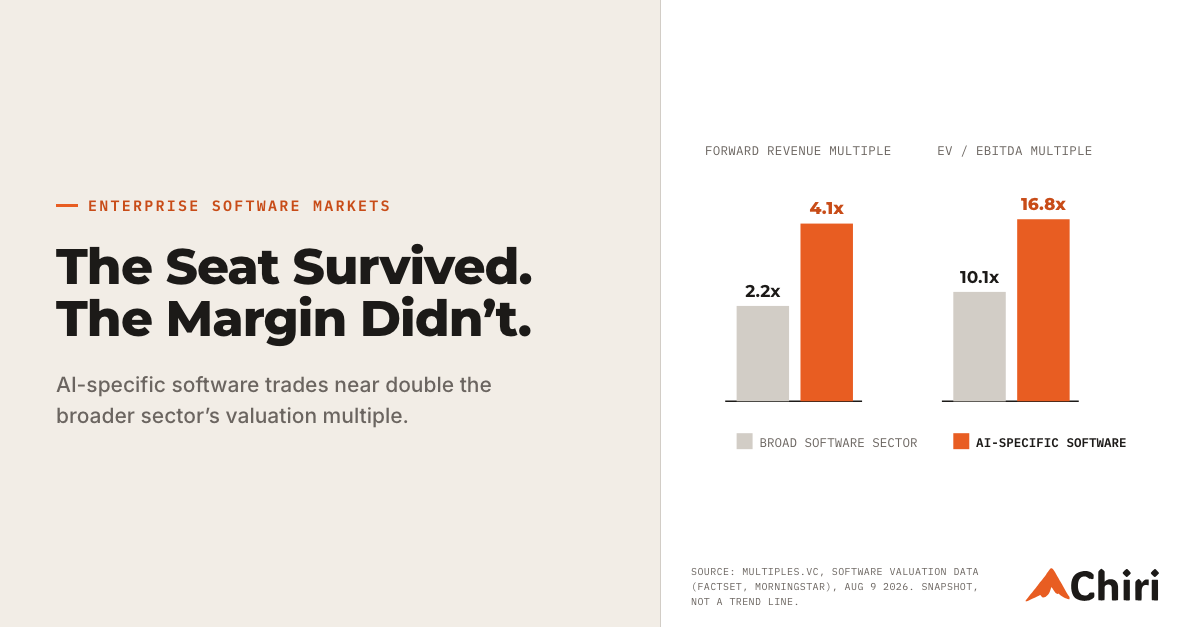
Multiples.vc published software valuation data on August 9, 2026, sourced to FactSet consensus estimates and Morningstar historical data. The overall software sector carried a median multiple of 2.2x forward revenue and 10.1x EV/EBITDA that month. AI-specific software names carried a median of 4.1x forward revenue and 16.8x EV/EBITDA in the same period, roughly double the broader sector on both measures.
That spread is a snapshot, not a trend line. The source page carries no prior-period comparison, so the data cannot show whether the gap widened, narrowed, or held steady over time. The correct claim is narrower than a re-rating headline: a spread this wide, sitting alongside incumbent software absorbing AI defensively rather than monetizing it as a new product line, is consistent with the AI premium accruing to a different set of companies than the legacy vendors named in Bersin’s post. It does not prove that a shift happened. It shows a market state that fits the shift better than it fits a flat story where nothing changed.
Named incumbents were not identified as the “AI-specific” names carrying that premium. If they were priced as commodity software rather than AI software, the multiple gap is one data point suggesting the premium sits with a different set of companies, not with the vendors that kept their seats.
Ben Thompson’s bottleneck
Ben Thompson’s August 24, 2026 Stratechery piece, “Autonomy and Innovation,” offers a mechanism for why that gap might exist. His argument, paraphrased here rather than quoted, is that incumbent software stays structurally bottlenecked by a human-in-the-loop design assumption baked into decades of product architecture. Faster-moving companies are not bound by that assumption, and they can automate steps that incumbent products still route through a person.
That gap is not a feature gap. Workday can ship an AI assistant inside its own interface. What it cannot do as easily is remove the human approval step, the manual configuration, and the change-management process that its own customers built their operations around. The incumbent’s constraint is organizational as much as technical, and it sits outside what any single product release can fix.
Where Chiri diverges: the value moved to delivery
Bersin’s read of the incumbent survival data holds. Where this analysis diverges is on where the displaced value actually went.
Enterprise buyers have largely stopped asking which HR platform is objectively best on paper. Feature lists across Workday, Oracle, SAP, and their peers have converged enough that the question no longer decides a deal. The question buyers ask instead is who will make the software work inside their specific environment, on their systems, integrated with their data, by a real deadline. That question is a delivery question, not a product question, and it does not get answered by the software vendor’s feature roadmap alone.
Whoever answers that question captures the premium the multiples data hints at. It is not automatically the incumbent, and it is not automatically an AI-native challenger either. It is whoever owns the last mile: the integration, the configuration, the change management, and the outcome the buyer actually paid for.
The incumbents kept their seats because ripping out a platform is expensive and disruptive. That was never where the AI premium was going to land. It lands with whoever closes the gap between a shipped feature and a company actually running on it.
This is the pattern behind Chiri’s sixth and seventh doctrines. AI re-rates services up and product down, because a feature that any vendor can ship stops being a differentiator the moment every vendor ships it. The delivery layer, the work of making a system function inside a specific company’s environment, is what captures the re-rating instead.
The role that does not exist yet
Thompson’s bottleneck points at something concrete inside most mid-market companies: nobody owns the end-to-end workflow. A company can buy Workday, buy an AI overlay, and still have no single function responsible for the outcome the AI was supposed to produce. IT owns the software. HR owns the process. No one owns the seam between them, and that seam is exactly where automation stalls.
That gap is structural, not a temporary skills shortage. Filling it does not require a company to abandon its incumbent platform. It requires a defined owner for the workflow that runs on top of the platform, someone accountable for the outcome rather than for the software license. Until that role exists, the AI feature sitting inside Workday or SAP stays a capability the company owns but does not fully use.
The software vendors solved the model access problem. Nobody solved the ownership problem. A workflow with no owner does not automate itself just because a better model sits underneath it.
This lands differently depending on where you sit
- HR and IT platform buyers. Renewing Workday, Oracle, ADP, SAP, HiBob, Docebo, or Cornerstone is a reasonable decision on its own. The open question is who owns the outcome the AI feature is supposed to produce, since the platform vendor rarely does.
- Incumbent software vendors. Retaining the seat is real and defensible. It is not the same as capturing the valuation premium the AI multiples data shows. Shipping a feature protects the base. It does not, by itself, move the company into the higher multiple band.
- Systems integrators and delivery partners. The multiple spread between AI-specific software and the broader sector is one signal that the premium is available to whoever delivers the outcome, not only to whoever writes the code.
- Analysts and industry watchers. Incumbent survival and value migration are two different claims. A report that confirms the first should not be read as having settled the second.
Who inside a company that just renewed its HR platform actually owns the outcome the AI feature was supposed to deliver?