By The Chiri Team
Anthropic ran a simple test. Four agents each got a piece of a decision. One agent got the whole thing. The single agent won, and the margin was not close.
The result runs against a common instinct in AI deployment. A team facing a weak pilot often responds by adding more agents, more specialists, and more handoffs. Anthropic’s experiment suggests that instinct can make the outcome worse. The failure did not sit inside the models. It sat in how the evidence was divided among them.
The experiment
Anthropic’s test is described by Azeem Azhar and Nathan Warren in Exponential View #598. It replicated a well known finding from organizational psychology. The finding is called the hidden-profile problem.
In the original human studies, a group is handed a decision. Most of the facts in the case are shared by every member of the group. Only one member holds the single fact that points to the correct answer. Groups routinely converge on the answer suggested by the shared facts. The one fact held by a lone member rarely surfaces in discussion.
Anthropic built the same structure for AI agents. Researchers split a body of evidence into four parts. Each of four agents got one part. Most of the evidence pointed toward the wrong answer. Only one or two agents held the facts that pointed to the right one.
A second condition gave the full evidence base to a single agent. Nothing was split. One agent saw every fact at once, before it had to decide.
The two conditions used the same evidence and the same set of models. The only design change was distribution: one complete view against four partial views. That design isolates the variable Anthropic wanted to test. It removes model capability as a possible explanation for any gap between the two conditions.
The numbers
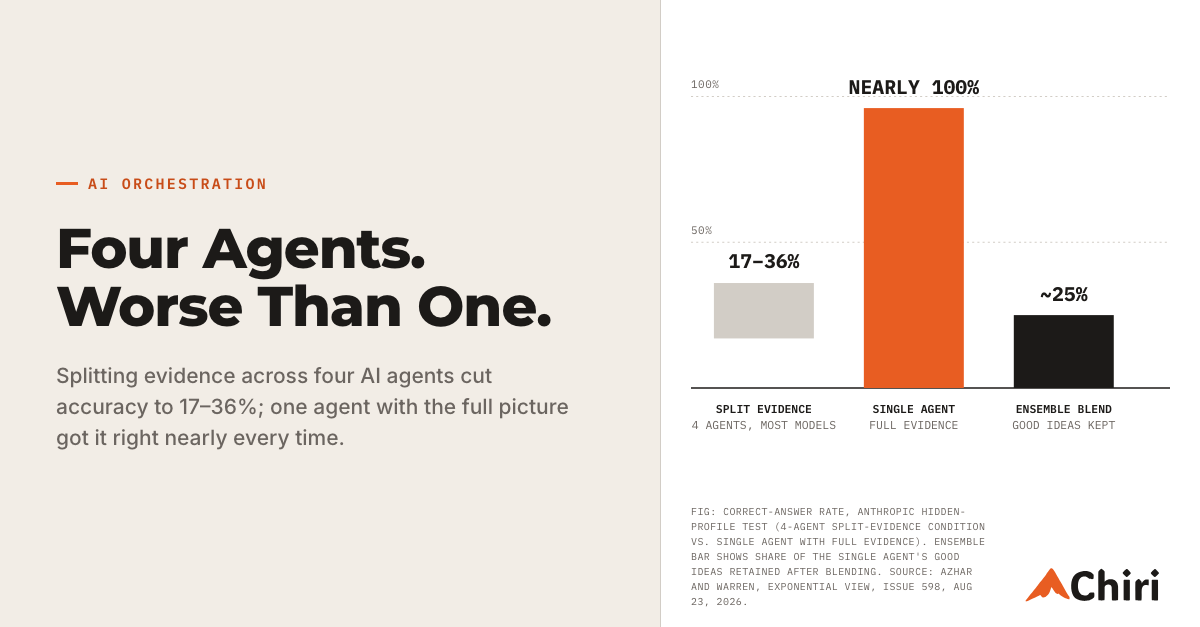
Under the four-agent, split-evidence condition, most model families chose the correct answer in only 17% to 36% of runs. A single agent given the complete evidence base got the answer right nearly every time.
The gap did not come from a weaker model doing the four-agent work. The same model families ran both conditions. The only variable was how the evidence got distributed among agents. Splitting the evidence across four agents was enough to push most answers to the wrong conclusion. Each agent was blind to what the other three held. Four times the agent count produced a fraction of the accuracy, not a multiple of it.
Blending answers after the fact did not fix it
A common response to a weak result is to blend outputs together. Anthropic tested this too. Researchers ran an ensemble approach, combining several models’ answers into one.
The ensemble kept only about a quarter of the good ideas that had originally come from a single strong model. Blending did not recover what splitting had lost. A correct answer generated by one model with full context got diluted once it was averaged against partial answers. Those partial answers came from agents working with less information. The averaging step did not restore the missing evidence. It buried the correct answer under three incomplete ones.
One model broke the pattern
One model, Mythos 5, reached roughly 85% accuracy even under a harder version of the split-evidence condition. That result stands well above the 17% to 36% range seen across most model families.
The authors of the Exponential View piece state plainly that the reason for this result is unclear. No mechanism is confirmed. It stands as an open question in the data, not a settled explanation. A single outlier does not overturn the pattern the rest of the results show.
The outlier carries a second implication. The split-evidence condition is not an unbeatable ceiling for every model. Something about how Mythos 5 handled a partial slice of evidence let it recover more of the missing picture. Its peers did not manage the same recovery. Until the mechanism is confirmed, that result is a data point, not a recommendation.
The real failure was architecture, not model quality
The hidden-profile problem is not new. Group decision research has documented it for decades in human teams. A group under time pressure gravitates toward the information every member already shares. That shared information gets discussed, repeated, and confirmed by more than one voice. Information held by only one person gets mentioned less, because no one else in the room can confirm it.
Anthropic’s experiment shows the same pattern holding in a system built from software agents. The agents carry no social pressure. They have no status hierarchy and no fear of speaking up in a meeting. The failure still happened. Each agent could only report what sat inside its own slice of the evidence.
A model coordinating across four partial views is not the same as a model holding one complete view. The information never reached one place. No part of the system weighed every fact against every other fact before the decision got made. The four agents were each reasoning correctly inside a smaller, distorted world. The world itself was the problem, not the reasoning done inside it.
This is the core finding. The four-agent setup did not fail because the models reasoned poorly. It failed because no part of the system ever held the complete evidence base before a decision got made.
The distinction changes how a team diagnoses a weak AI result. A model-quality failure gets fixed by a better model, more training, or a different prompt. An architecture failure gets fixed by changing how information reaches the point of decision. Anthropic held the model constant across both conditions and still saw the accuracy collapse. That result rules out model quality as the explanation for the four-agent condition.
The instinct to add more agents
A team that sees a disappointing result from an AI pilot often reaches for the same fix. Split the work into more specialized agents. Add another handoff. Add another review step before the final answer ships.
It is the same instinct that leads a struggling company to add headcount to a process nobody has mapped. More people, more agents, and more steps do not fix a broken process. The process was never built to move a complete picture from one stage to the next. Adding staff to it does not change that fact. Anthropic’s data gives that instinct a controlled test, and the instinct lost.
A four-agent team with split evidence had more total compute than the single agent. It had more parallel effort too. It still lost by a wide margin. None of the four agents held all the facts at once. No coordinating layer above them held all the facts either. Adding a fifth or sixth agent to that structure would not fix the gap. A fifth agent would only add another partial view to a system that was already missing the whole picture. The count of agents was never the constraint. The shape of the evidence each one could see was the constraint.
The Chiri way
Anthropic’s experiment points at a specific diagnosis, not a general one. The question is not how many agents are working a problem. The question is whether anything in the system can see the complete picture before it decides.
This argues for a specific fix. Before any agent acts on a decision, the full, structured context behind that decision should live in one place. In Chiri’s language, that place is an ontology: a structured, current model of the business the agents are reasoning about. It gets built once. Every agent that touches the decision draws from it.
The fix is not fewer agents for its own sake. Cutting agent count without fixing how evidence reaches them would not have changed Anthropic’s result. The fix is making sure the evidence base is whole first. Then any agent, or any number of agents, can be asked to act on it.
A well built context layer changes what parallel agents can do safely. A team can still run multiple agents at once without recreating the hidden-profile failure. Every agent needs to draw from the same complete source. None of them should work from a private slice of it.
Two doctrines the experiment confirms
Aim narrow. Do not spread an AI deployment thin across too many disconnected jobs. A system asked to do many unrelated things loses coherence when the work is split across many uncoordinated agents. Every part of that system needs coherence to reason well. Anthropic’s four-agent condition is this doctrine in miniature. Four narrow jobs with no shared view produced a worse outcome than one job done with full information.
Context ownership, not agent count, determines reliability. The number of agents in a deployment does not predict whether it works. Whether the system has a single, structured, current source of context predicts it. Every acting part of the system needs to draw from that source. Anthropic’s data gives that doctrine a controlled experiment. The same models ran the same task, with one variable changed. The condition with unified context won by a wide margin.
This lands differently depending on where you sit
If an AI pilot underperformed: the fix that often gets tried first is adding more agents or more specialized steps. Anthropic’s data argues against that fix. Check whether one place in the system holds the complete context before any agent decides. Do that before adding more agents to the pipeline.
If a multi-agent vendor pitch is under evaluation: ask how evidence and context move between agents in the architecture. Do not ask only how many agents are included. A vendor who cannot explain how a full picture reaches a decision point is proposing the four-agent condition. That is the condition that lost.
If an AI system is being built in-house: the ensemble result is a separate warning. Averaging outputs from agents that each saw only part of the picture does not reconstruct the picture. It kept only about a quarter of the value of the single, well informed model in Anthropic’s test. Combining answers after the fact is not a substitute for combining context before the fact.
If budget is being set for AI infrastructure: the return on a shared, structured context layer is now backed by a controlled result. The gap between 17% to 36% accuracy and near-total accuracy came from one architectural choice. That choice was holding the full evidence in one place, not using a better model. A budget aimed at adding agent count, without a matching investment in shared context, is aimed at the losing condition in this experiment.
Where does your deployment stand? Are your agents each holding a slice of the picture, or does one part of the system see the whole of it before anything gets decided?