Sovereignty at a price only the Fortune 50 can pay, or convenience paid for with your alpha. Here’s how to tell which tier you’re actually buying into.
By The Chiri Team
If your AI vendor disappeared tomorrow, would you lose a tool, or would you lose the thing that makes your business different?
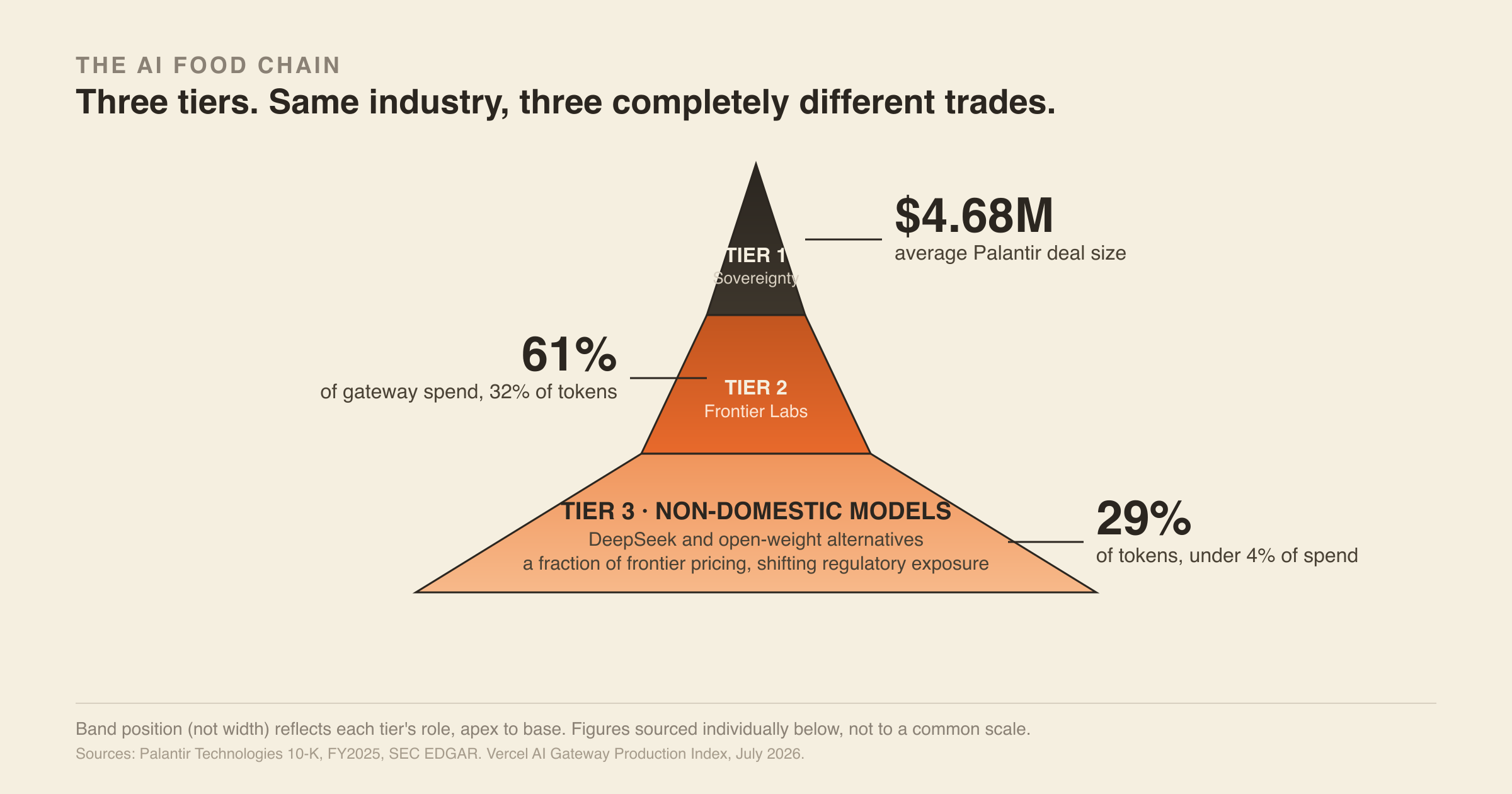
Few executives have actually sat down and answered that question, because most AI purchasing decisions get made on capability and price, not on where the vendor sits in a much bigger structure. That structure has three real tiers, and which one you are buying into determines a lot more than your bill.
| Tier | What you get | What it costs you |
|---|---|---|
| 1. Sovereignty (Palantir) | Full data and model ownership | $800K-$1.5M+ minimum ACV |
| 2. Frontier labs (OpenAI, Anthropic, etc.) | Convenience, best-in-class capability | Your usage becomes their signal |
| 3. Non-domestic models | A fraction of frontier pricing | Regulatory exposure that shifts monthly |
Tier one: sovereignty, priced for the Fortune 50
Palantir is the clearest example of what full data sovereignty costs. The company’s model is forward-deployed engineers embedded on-site, 20 to 40 per major account, billed near $1 million a year each, which forces a structural floor on deal size. Foundry’s effective minimum ACV runs $800,000 to $1.5 million, the average customer pays $4.68 million, and 55 percent of customers are government. (Palantir Technologies 10-K, FY2025, SEC EDGAR)
That is a real, defensible answer to “who owns my data and my model,” and Palantir CEO Alex Karp has been publicly blunt about why he thinks it matters, telling CNBC’s Squawk Box on July 1, 2026 that AI labs are “stealing weights and alpha” from enterprise customers and calling for what he terms AI sovereignty, companies owning their compute, data, and models rather than renting all three. (CNBC)
Karp has an obvious commercial interest in that framing. He is also describing a real tier of the market, one that almost no mid-market company can actually afford to buy into.
Tier two: the frontier labs, where convenience is the product and your usage is the payment
Most companies are not buying Palantir. They are buying a seat license or an API key from a frontier lab, and the arrangement looks like a straightforward vendor relationship. It is not quite that simple. Even under a zero data retention agreement, the model provider can often still infer the shape of what you sent it, because reconstructing input from output is fundamentally a distance problem across a high-dimensional embedding space, not a data-storage problem. That is how the underlying technology works, promise or no promise.
Watch what happens when a foundation model provider learns enough about a vertical to compete in it directly. When Anthropic launched a legal plugin for Claude on February 3, 2026, automating contract review, NDA triage, and compliance tracking, Thomson Reuters fell 16 percent that day and RELX fell 14 percent in its steepest single-day drop since 1988. (Morningstar, February 2026) Nobody signed a contract agreeing to train Anthropic’s next vertical product. It happened anyway, as a byproduct of aggregate usage across thousands of customers, which is exactly the mechanism Karp is warning about, whether or not you buy his solution.
This tier is not a bad place to be. It is the right tier for most workloads, most of the time. It is a bad place to put the workflow that is actually your competitive edge, without knowing that is what you are doing.
Notice, too, that the labs in this tier are not united on how the whole food chain should even be structured. In late July 2026, OpenAI and Anthropic found themselves publicly on one side of a fight with the rest of the industry, Nvidia, Microsoft, Meta, and much of venture capital on the other, over whether powerful models should stay tightly controlled or be shared as open weights. Jensen Huang used his first-ever post on X to back the open side: “The world needs both frontier closed models and frontier open models.” Both camps have a real argument and a real commercial interest in winning it. (Mike Isaac, “The Fight Tearing Apart Silicon Valley,” The New York Times’ The Daily, July 31, 2026) The point for you is not to pick a side of that fight. It is to recognize that the structure of this tier is actively being contested by the people who built it, which is one more reason not to treat “which model” as a settled, static decision.
Tier three: the non-domestic models, where the price is real but so is the regulatory exposure
The third tier is the one getting the most attention right now, and for a good reason: non-domestic, primarily Chinese-origin, models are running at a fraction of frontier pricing with capability close enough to matter for most business tasks. Coinbase has publicly disclosed cutting its AI spend roughly in half by defaulting engineers to Zhipu’s GLM 5.2 and Moonshot’s Kimi 2.7. (MLQ News) That is a real, provable cost advantage.
It comes with a different kind of exposure than tiers one and two. The FY2026 NDAA’s Section 1532 already excludes DeepSeek-linked AI from Department of Defense systems and contractors. The Pentagon’s June 2026 update to its Section 1260H list of Chinese military-linked companies added Alibaba and Baidu, bringing the total to 188 entities, with contracting restrictions phasing in through 2027. (WilmerHale) None of that makes a private company’s use of these models illegal today. It does mean the ground is shifting fast enough that a company routing sensitive workloads through this tier needs a real answer to whether it touches a federal customer, a defense contract, or a fast-expanding restricted list, not just a spreadsheet showing the price is lower.
Where the mid-market actually lives, and what it needs instead
Most operationally complex mid-market companies do not need Palantir’s price tag, cannot fully outsource to a frontier lab without a real answer on data exposure, and are not equipped to run their own threat model on non-domestic routing. That gap between the three tiers is not a footnote, it is where most of the market actually sits, underserved by all three options as they are typically sold.
What that gap needs is not a fourth model. It is a governed layer that routes each workload to the right tier deliberately, frontier where accuracy matters most, cost-efficient where it doesn’t, with a real, enforceable zero data retention agreement standing behind the workflows that touch what makes your business distinct, instead of a settings-page checkbox. That is a decision an executive team can make on purpose, instead of discovering after the fact which tier they accidentally bought into.
Where are you in this structure right now, and did you choose that spot deliberately?
Sources cited:
- Palantir Technologies 10-K, FY2025, SEC EDGAR: revenue, gross margin, average ACV, customer mix.
- CNBC, “Palantir’s Karp bashes token-based AI model as ‘completely wrong,’” Alex Karp on Squawk Box, July 1, 2026. https://www.cnbc.com/2026/07/01/palantir-karp-open-ai-anthropic-tokens.html
- Morningstar, “Thomson Reuters, RELX, and Wolters Stocks Crushed After Anthropic Debuts Claude Legal Plug-In,” February 2026. https://www.morningstar.com/stocks/reuters-relx-wolters-stocks-crushed-after-anthropic-debuts-claude-legal-plug-in
- MLQ News, “Coinbase Switches to Chinese AI Models GLM and Kimi, Cuts AI Spending by 50%.” https://mlq.ai/news/coinbase-switches-to-chinese-ai-models-glm-and-kimi-cuts-ai-spending-by-50/
- WilmerHale, “Pentagon Adds 65 New Entities to the 1260H List,” June 2026. https://www.wilmerhale.com/en/insights/client-alerts/20260611-pentagon-adds-65-new-entities-to-the-1260h-list-of-chinese-military-companies
- Mike Isaac, “The Fight Tearing Apart Silicon Valley,” The New York Times’ The Daily, July 31, 2026 (transcript). https://www.nytimes.com/2026/07/31/podcasts/the-daily/ai-open-source-china-silicon-valley.html