By Mat Caldwell, CEO and co-founder, Chiri AI
A few weeks ago an AI model was released and my engineering team could not stop talking about it. The channel lit up before I had finished my coffee. The model was Kimi K3, and the excitement was not that it could do something nothing else could. It was that anyone could download it, run it, and own it.
That is the moment worth paying attention to. Not the benchmark. The ownership.
Two releases, one quarter, one signal
Look at what shipped this year from the open-weight side.
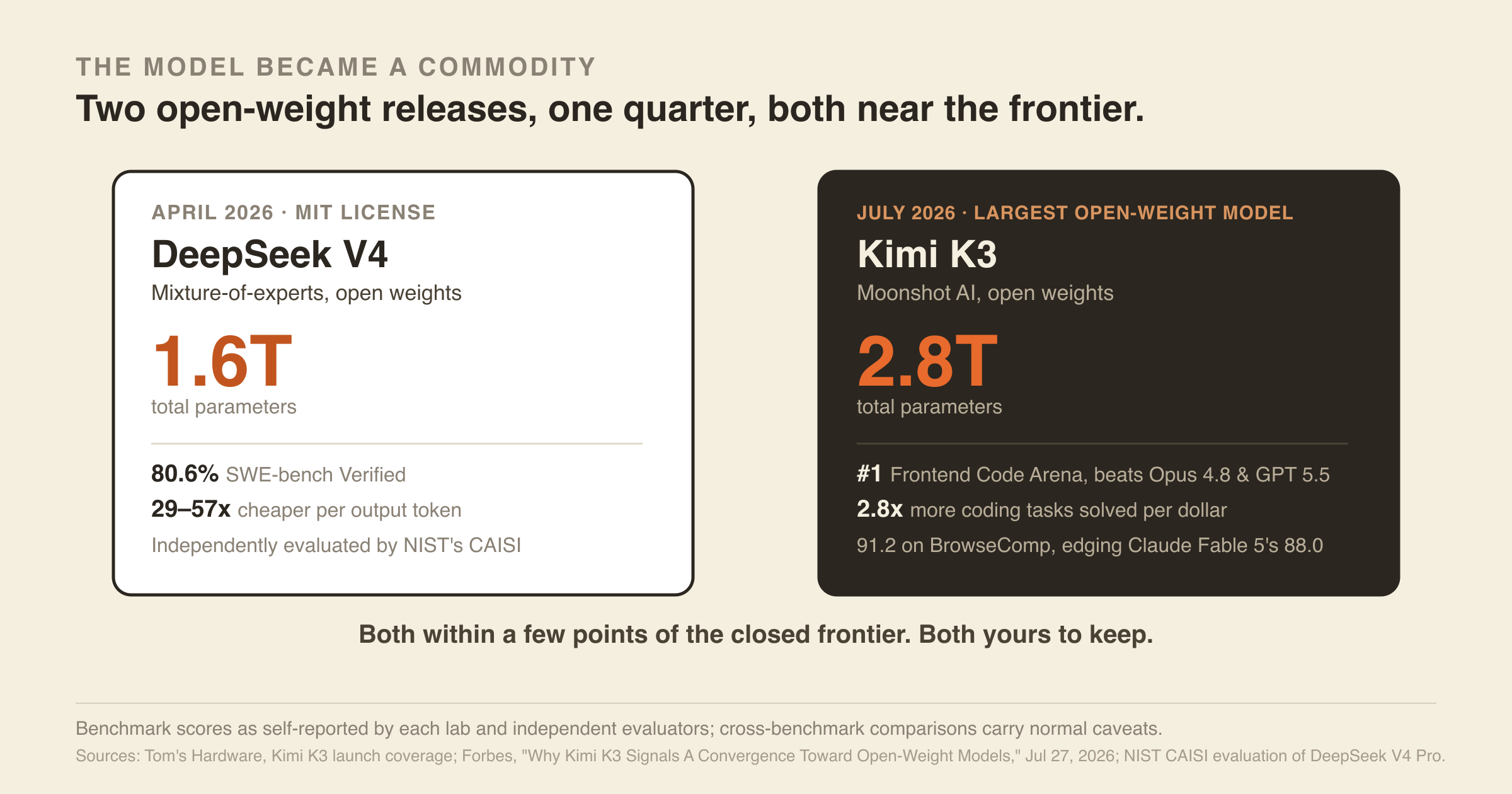
In April, DeepSeek released V4, a mixture-of-experts model at 1.6 trillion total parameters with open weights under an MIT license and a one million token context window. Its strongest configuration posted 80.6 percent on SWE-bench Verified, the highest score any open-weights model has recorded. That still trails the very top of the closed frontier. Claude Opus 4.8 sits at 88.6 percent and Claude Fable 5 at 95.0 percent. The number that stops you is the price. DeepSeek delivers that work at roughly 29 to 57 times less cost per output token than those closed models. It was independent enough to matter that NIST’s AI safety institute ran its own evaluation of it.
In July, Moonshot released Kimi K3 at 2.8 trillion parameters, the largest open-weight model anyone has published. It took first place on the Frontend Code Arena leaderboard and beat both Claude Opus 4.8 and GPT 5.5 on coding, while ranking just under Claude Fable 5 and GPT 5.6 Sol overall. On the BrowseComp research benchmark it scored 91.2, edging Claude Fable 5 at 88.0 and nearly matching GPT 5.6 Sol at 90.4. On a coding cost sweep it solved roughly 2.8 times more tasks per dollar than Claude Fable 5.
Two labs. One quarter. Both open. Both within a few points of the best closed models on real work, at a fraction of the price.
What is actually converging
The headline everyone reaches for is that open models are catching up. The more useful reading is about where the value is moving.
The frontier labs still hold the top of the capability chart, and for the hardest reasoning that lead is real. But for the large majority of enterprise work, the tasks that run thousands of times a day inside a company, open-weight models are now good enough, cheap enough, and yours to keep. When something becomes good enough, ownable, and cheap all at once, it stops being the scarce thing. It becomes the commodity layer.
The engineering behind these models makes the same point in a quieter way. Kimi K3’s headline advance is Kimi Delta Attention, a smarter way of handling memory that Moonshot credits with about 2.5 times better scaling efficiency than its previous model. DeepSeek uses its own sparse attention design to hit similar economics. The whole competition right now is about doing the same work for less. That is a cost race, and cost races end with the thing getting cheap for everyone.
One honest caveat, because it matters for how you use these systems. These efficiency techniques trade some exact recall for speed. A model can accept a million tokens of context and still not remember every fact inside it perfectly. Feeding a model more raw material is cheaper than it has ever been. Feeding it the right material, structured so it can be trusted, is a different problem. That distinction is the whole game.
The asset moved down the stack
Here is the way I would draw the enterprise AI stack today, and where the value now lives.
The model layer is commoditizing fast. A new open one lands every quarter.
The context layer is your institutional knowledge. It is scarce, and it is yours.
The workflow layer is how the work actually gets done. It is the hardest thing to copy.
For two years most companies spent their attention and their budget on the top layer, picking a model and wiring to a single vendor. That was a reasonable bet when the model was the scarce thing. It is not the scarce thing anymore. The advantage is moving down the stack, toward the knowledge a company holds and the structure it lives in.
This is why raw context length, on its own, is a trap. Dumping every document a company owns into a model and hoping the right five paragraphs surface is not a knowledge strategy. It is a search strategy, and a lossy one. What makes company knowledge usable by a machine is structure. The relationships between a policy, the team that owns it, the customer it applies to, and the decision it once drove. That structure is an ontology, a living knowledge graph of how the business actually works.
What this unlocks for Chiri
We built ChiriBrain on a bet that the model would commoditize and the knowledge would not. This quarter that bet started paying off in public.
Two things change for the companies we work with.
The first is that cost control stops being a one-time win and becomes a compounding one. Chiri is model-agnostic by design, routing across hundreds of models and sending each task to the one that fits it. When a new open model like K3 or DeepSeek V4 arrives, it becomes a new, cheaper rung on that ladder. Not a migration, not a rebuild. Every workflow paying frontier prices for work that does not need frontier reasoning can step down a rung the week a better open model ships. The savings keep coming as the market keeps improving.
The second is bigger. Open weights make ownership real. Until now, a company could own its data, its agents, and its workflows, and still rent the intelligence from a vendor who could deprecate a model or reprice it overnight. There is now a class of frontier-adjacent models good enough to run serious work that cannot be taken away from you. Paired with an ontology that is captured, owned, and governed by the company itself, that is a system a business genuinely controls end to end. The living knowledge graph is the part no competitor can download.
The efficiency gains matter here too, with the caveat attached. Cheaper long context means an agent can reason over far more of a company’s real knowledge before it answers, instead of a handful of retrieved snippets. The structure is what keeps that reliable. More context plus a real ontology is a materially smarter agent. More context alone is just a bigger haystack.
The part that does not get cheaper
I spent 25 years in people operations before I helped start this company, so let me end where the real work is.
A cheaper model does not know how your controller actually closes the books. It does not know the unwritten rule your best account manager follows, or the reason a process exists that no document explains. That knowledge lives in people, and capturing it is the hard, human part of this work. It always was.
Commodity intelligence does not change that. It raises the value of it. When the model is cheap and ownable, the scarce advantage becomes the knowledge your people hold and whether you have made it usable. The agents take the repetitive work off their plates so those people can do the work that actually needs them, the judgment and the relationships and the decisions a machine should never make alone.
Companies built before AI shouldn’t be left behind by it. The open-weight wave is the clearest sign yet that the tools are ready. Whether a company can use them comes down to something older and more human, which is how well it knows itself. Chiri is how you make the jump.
Sources cited
- DeepSeek V4 specifications, pricing, SWE-bench Verified scores, and cost comparison: morphllm.com/deepseek-v4; DeepSeek V4-Pro review, codersera.com/blog/deepseek-v4-pro-review-benchmarks-pricing-2026
- NIST evaluation of DeepSeek V4 Pro: nist.gov/news-events/news/2026/05/caisi-evaluation-deepseek-v4-pro
- Kimi K3 parameters, active experts, MXFP4/MXFP8 quantization, Frontend Code Arena result, comparisons to Claude Opus 4.8, GPT 5.5, Claude Fable 5, and GPT 5.6 Sol, 2.5x scaling efficiency, Kimi Delta Attention: tomshardware.com/tech-industry/artificial-intelligence/moonshot-releases-2-8-trillion-parameter-kimi-k3
- Kimi K3 cost-per-task and BrowseComp figures, open-weight convergence argument: forbes.com/sites/geruiwang/2026/07/27/why-kimi-k3-signals-a-convergence-toward-open-weight-models
- Kimi K3 as largest open-source model, rivaling top US systems: venturebeat.com/technology/chinas-moonshot-ai-releases-kimi-k3-the-largest-open-source-model-ever-rivaling-top-u-s-systems
Mat Caldwell