Jensen Huang picked a fight over open weights. The fight that actually matters to your business is smaller, more concrete, and it’s already inside your vendor contracts.
By The Chiri Team
Could your business swap the model behind its core AI workflow next quarter, or would that require a re-platform?
On July 24, 2026, Jensen Huang used his first-ever post on X to pick a very public fight, sharing an open letter, “Open Weights and American AI Leadership,” signed initially by Nvidia, Microsoft, Meta, Palantir, and roughly twenty other companies:
> “AI will transform every industry, power every company, and be built by every country. Open models strengthen safety and cybersecurity, accelerate innovation and diffusion, and enable sovereignty. The world needs both frontier closed models and frontier open models.”
Satya Nadella posted a similar message nine minutes later. Elon Musk replied, “Jensen is right. This has my full support.” Mark Zuckerberg quote-posted his agreement the same day, then wrote a Wall Street Journal op-ed making the same case. OpenAI and Anthropic pushed back, arguing that open-weight models handed to any actor are a genuine safety risk. By the following week the letter had more than 230 signatories. (Mike Isaac, “The Fight Tearing Apart Silicon Valley,” The New York Times’ The Daily, July 31, 2026; “Open Weights and American AI Leadership,” full text hosted by Microsoft)
That fight is real, and it is not your fight. It is a fight about US-China policy and export controls, fought by companies with a direct commercial stake in how Washington rules. Your version of this fight is smaller, more concrete, and it does not require a single geopolitical argument to make.
The lock-in you should actually be worried about isn’t happening in Washington
It is happening in your renewal contracts:
- Google bundled Gemini directly into Workspace Business and Enterprise plans at no extra charge starting in January 2025, retiring the old standalone add-on.
- Microsoft made its “Business Standard with Copilot” and “Business Premium with Copilot” bundled SKUs permanent as of July 1, 2026, priced below buying the pieces separately.
- Salesforce now sells Agentforce 1, an edition that bundles AI credits directly into the base CRM license rather than as an a la carte add-on.
Each of these is a reasonable product decision by the vendor, and each one is also a nudge toward the same outcome: the AI layer running a growing share of your operations arrives pre-selected, priced to make the bundle the easy default, with no real evaluation step in between.
If you are old enough to have lived through an ERP rollout in the 2000s, you already know exactly how this story ends if nobody interrupts it. SAP, Oracle, and PeopleSoft implementations became notorious for a specific reason: once a company’s core processes were built around one vendor’s data model, switching cost more than staying, for years, regardless of whether the vendor was still the best option. Multi-year lock-in and six-figure rip-and-replace costs were not an accident of bad luck. They were the predictable result of adopting a platform without ever building the muscle to leave it. AI is heading toward the same structure, faster, because the switching cost compounds with every workflow that gets built around one model’s specific behavior.
Why a values statement alone would not be worth writing
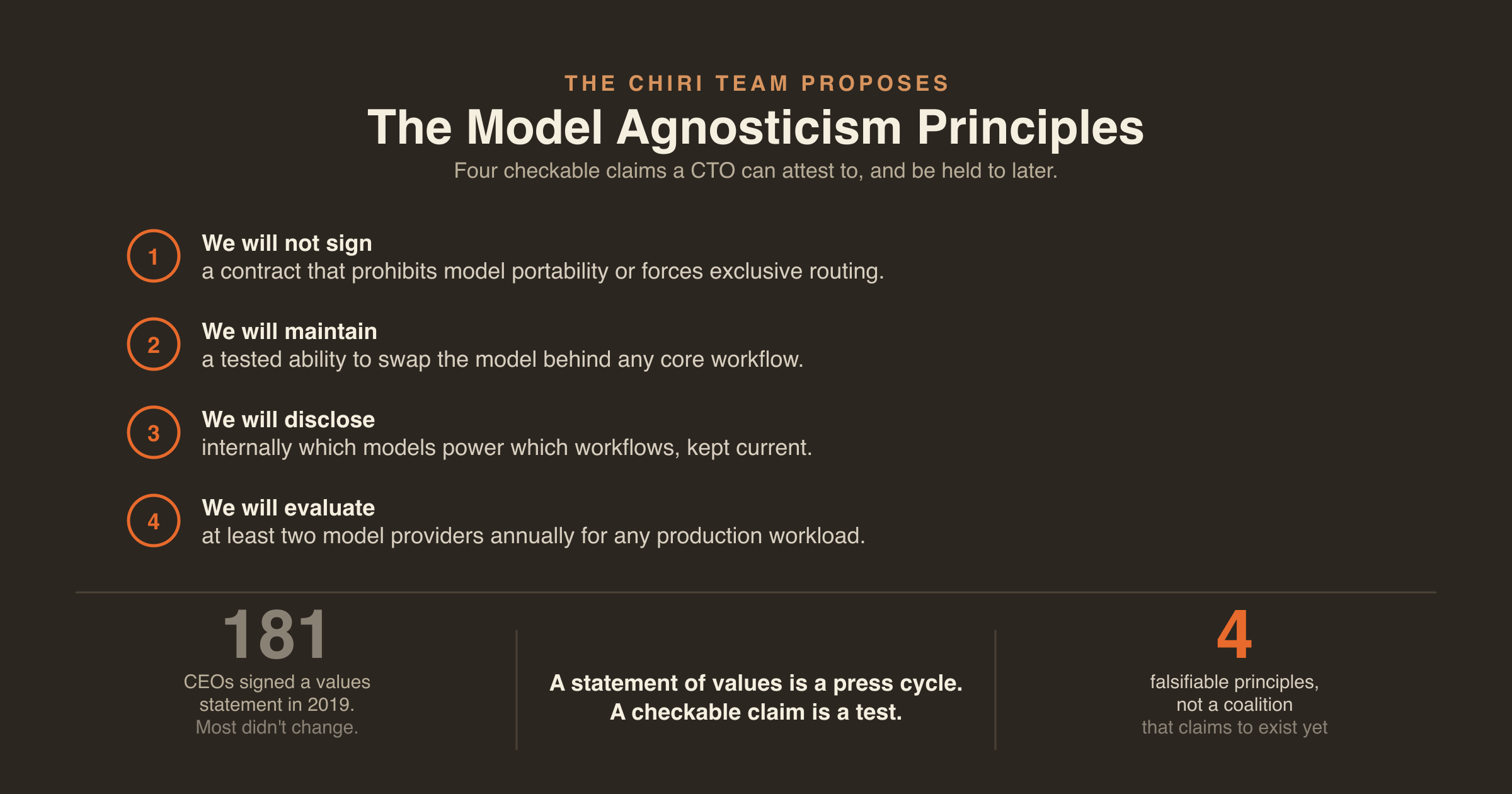
In August 2019, 181 CEOs signed the Business Roundtable’s “Statement on the Purpose of a Corporation,” publicly committing their companies to deliver value to all stakeholders, not just shareholders. It generated real press attention. Years later, researchers and institutional investors examined whether signatory companies actually changed behavior, and the consensus was that most did not: the statement did not alter a single director’s fiduciary duties, and lobbying and governance practices at signatory companies largely continued as before. A statement of values, without a checkable commitment behind it, is a press cycle, not a change in how anyone operates.
So here is what we are proposing instead, and why it looks different from a values statement. Four specific, checkable claims a CTO can actually attest to, and can be held to later:
- We will not sign an AI vendor contract that prohibits model portability or forces exclusive routing through a single foundation model.
- We will maintain a documented, periodically tested ability to swap the underlying model behind any core workflow without a full re-platform.
- We will disclose internally, to our own employees, which models power which workflows, and keep that disclosure current.
- We will evaluate at least two model providers annually for any AI workload doing real production work.
None of these require picking a side in the open-versus-closed fight Huang started. None of them require you to distrust any specific vendor. They require you to keep the option to leave real, the same discipline a well-run procurement function already applies to every other critical vendor relationship, applied here before the switching cost compounds the way it did with ERP.
This is a proposal, not an announcement
We have not signed this yet ourselves in any formal sense beyond writing it down, and we are not claiming a coalition that does not exist. What we are doing is putting a specific, falsifiable standard on the table and inviting the CTOs and CIOs who actually run mid-market technology stacks, the people who will live with this decision in three years whether they made it deliberately or by default, to tell us where it is wrong before we ask anyone to sign it.
Each seat in the room has a different stake in this:
- The CTO is the one who has to actually build and test the swap capability principle four describes, not just claim it.
- The CFO is the one who has to weigh the near-term convenience of a bundled contract against the switching cost it quietly creates.
- The CEO is the one who will have to explain, years from now, why the company let its AI layer get chosen by whichever platform vendor happened to bundle it in first.
- The COO owns what breaks operationally the day a bundled model changes, degrades, or gets deprecated with no fallback in place.
Could your business actually attest to all four of these principles today? If not, which one would take the most work to make true?
Sources cited:
- Mike Isaac, “The Fight Tearing Apart Silicon Valley,” The New York Times’ The Daily, July 31, 2026 (transcript). https://www.nytimes.com/2026/07/31/podcasts/the-daily/ai-open-source-china-silicon-valley.html
- “Open Weights and American AI Leadership,” open letter, full text hosted by Microsoft, launched July 24, 2026. https://www.microsoft.com/en-us/corporate-responsibility/topics/open-weight/
- Business Roundtable, “Statement on the Purpose of a Corporation,” August 19, 2019, 181 signatory CEOs, and subsequent institutional-investor and academic analysis of signatory behavior change.
- Google Workspace pricing and Gemini bundling announcement, January 2025 and 2026 updates.
- Microsoft 365 Copilot bundled SKU pricing (Business Standard/Premium with Copilot made permanent July 1, 2026) and standalone add-on pricing, 2026.
- Salesforce Agentforce 1 bundled edition pricing, 2026.