
Your token bill is subsidized today. What happens to the roadmap the day it isn’t.
By The Chiri Team
What happens to your AI roadmap the day your token bill stops being subsidized?
That is not a rhetorical setup. It is a question with a specific, researched answer, and it is one few executives have actually sat with, because the subsidy has been quiet enough not to notice.
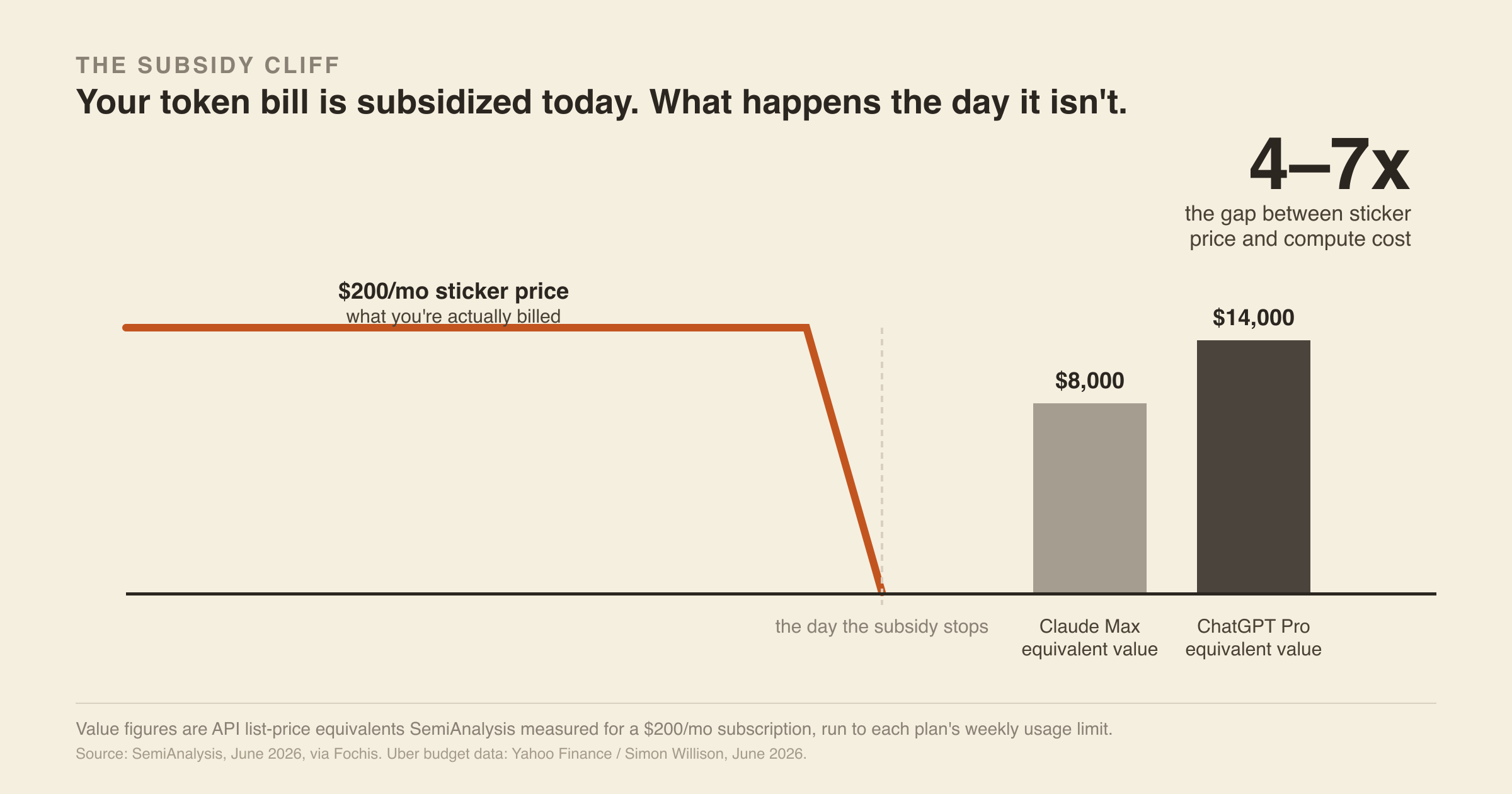
SemiAnalysis tested this directly in June 2026, buying every Anthropic and OpenAI subscription tier and running long-horizon agentic coding sessions until each plan’s weekly limit hit. The result, for the same $200 monthly subscription:
- Claude Max delivers roughly $8,000 a month in equivalent value at API list prices.
- ChatGPT Pro delivers roughly $14,000.
The old rule of thumb, that a $200 plan was worth about $2,000 in tokens, was off by a factor of four to seven. (SemiAnalysis, via Fochis) That gap between sticker price and actual compute cost is not generosity. It is a subsidy, and subsidies are a choice a company can stop making.
Uber already found the edge of the subsidy, the hard way
Uber blew through its entire 2026 AI budget in four months. One two-hour coding session alone cost $1,200. Engineers were previously running individual monthly bills between $500 and $2,000, encouraged by internal leaderboards ranking usage by team.
In response, Uber capped AI coding tool spend at $1,500 per engineer per month, with a real-time dashboard so people can watch their own consumption and a formal approval path if a workload genuinely needs more. COO Andrew Macdonald has been candid that it remains hard to tie the increased spend to measurable product improvement, even with AI agents now generating roughly 10 percent of Uber’s committed code. (Yahoo Finance, simonwillison.net)
That is the tokenmaxxing dilemma in one company’s real numbers. Reward maximum token usage, and usage maximizes. Cost follows. Value does not automatically follow with it. Uber’s fix was a hard cap, which works, but a cap is a blunt instrument. It caps the ceiling. It does not tell you which of the dollars underneath that ceiling were actually well spent.
Why the cost floor is rising, not falling, for the workloads that matter most
This is an executive-level problem, not just an engineering-team one, because of where the subsidy is concentrated. Coding tokens have been the most heavily subsidized category, because every frontier lab is fighting for developer mindshare. That subsidy does not extend evenly. Back-office reasoning, long-context analysis, and multi-step agentic workflows consume tokens at a much higher multiple per unit of output, and those workloads are exactly where a growing share of enterprise AI spend is now headed. As multi-agent systems become normal rather than experimental, a single business process can trigger a coordinated cascade of model calls, each one billed at list price with none of the coding-specific subsidy behind it.
That is the exponentiation problem in plain terms. Token costs rise fastest exactly where the subsidy is thinnest, which is exactly where a growing share of real business workflows live. A company that only budgeted based on what its coding assistant costs is going to be badly surprised by what its back-office agents cost once they scale.
The subsidy is also not static, and the direction it moves matters. On July 30, 2026, OpenAI cut prices 80 percent on GPT-5.6 Luna and 20 percent on GPT-5.6 Terra, and added a paid Fast mode for its flagship GPT-5.6 Sol, attributing the cuts to efficiency gains from the model itself, not goodwill. (CNBC) That is genuinely good news, but read the fine print of where the discipline is applied. The cuts land on the tiers already competing hardest for developer volume, the same coding-adjacent workloads that were already subsidized. Nothing in that announcement suggests the same discipline is coming for long-context reasoning or multi-agent back-office work, which is exactly the category this article is warning you about. A price war on the subsidized tier does not mean the unsubsidized tier gets cheaper too. It can mean the opposite, if a lab decides to fund the discount by tightening margin somewhere less visible.
This is where token economics becomes a business continuity question, not a budgeting one
When the cost floor for a given workload keeps climbing, a rational executive starts looking for the same capability at a lower price, and right now that search leads toward non-domestic models running at a fraction of frontier pricing. That is not disloyalty to a preferred vendor. It is the same instinct that makes a company multi-cloud, keep a backup supplier, or maintain a manual fallback if a critical system goes down. You do not bet the business on a single point of failure, and an unmanaged, exponentiating token bill from a single provider is exactly that kind of single point of failure.
The uncomfortable version of this argument is one worth saying plainly. If domestic model providers keep raising the effective price of frontier capability faster than budgets can absorb it, they are not protecting their market position. They are pushing the workloads that most need cost discipline, the ones a mid-market company actually depends on to run the business day to day, toward whichever provider can serve them at a sustainable price. Business continuity is not an abstraction. It is the operational reality of which vendor a company can still afford to run on next year.
What this means practically, before the bill forces the decision
Do not wait for a $1,200 coding session to force a policy. Build the discipline now: know which workloads are running on subsidized pricing today and will not be tomorrow, know your real per-workflow token cost at unsubsidized rates, and have a tested fallback for the workloads that matter most if your primary model’s pricing shifts under you. That is not paranoia. It is the same continuity planning every other critical vendor relationship in your business already gets, applied to the newest and fastest-growing line item on your P&L.
Each seat owns a piece of this decision:
- The CFO is the one who has to explain a budget line that can blow through a full year’s allocation in four months without warning, the way Uber’s did.
- The COO is the one who inherits the operational scramble if a critical workflow’s primary model gets re-priced or restricted with no fallback in place.
- The CTO is the one who has to have already tested the fallback before it is needed, not while it is needed.
- The CEO is the one who ultimately decides whether business continuity outweighs vendor loyalty, and when.
If your primary model provider doubled its effective price tomorrow, what would actually happen to your business the following week?
Sources cited:
- Fochis, “How Much of An AI Subsidy Are ChatGPT Pro 20x and Claude Max 20x Users Actually Getting?” citing SemiAnalysis, June 2026. https://fochis.com/articles/how-much-of-an-ai-subsidy-are-chat-gpt-pro-20x-and-claude-max-20x-users-actually-getting
- Yahoo Finance, “Uber blew its entire 2026 AI budget in 4 months,” June 2026. https://finance.yahoo.com/technology/ai/articles/uber-blew-entire-2026-ai-145000897.html
- Simon Willison, “Uber Caps Usage of AI Tools Like Claude Code to Manage Costs,” June 3, 2026. https://simonwillison.net/2026/Jun/3/uber-caps-usage/
- CNBC, “OpenAI cuts prices for two of its GPT-5.6 AI models as companies grow sensitive to costs,” July 30, 2026. https://www.cnbc.com/2026/07/30/open-ai-price-cut-gpt.html