
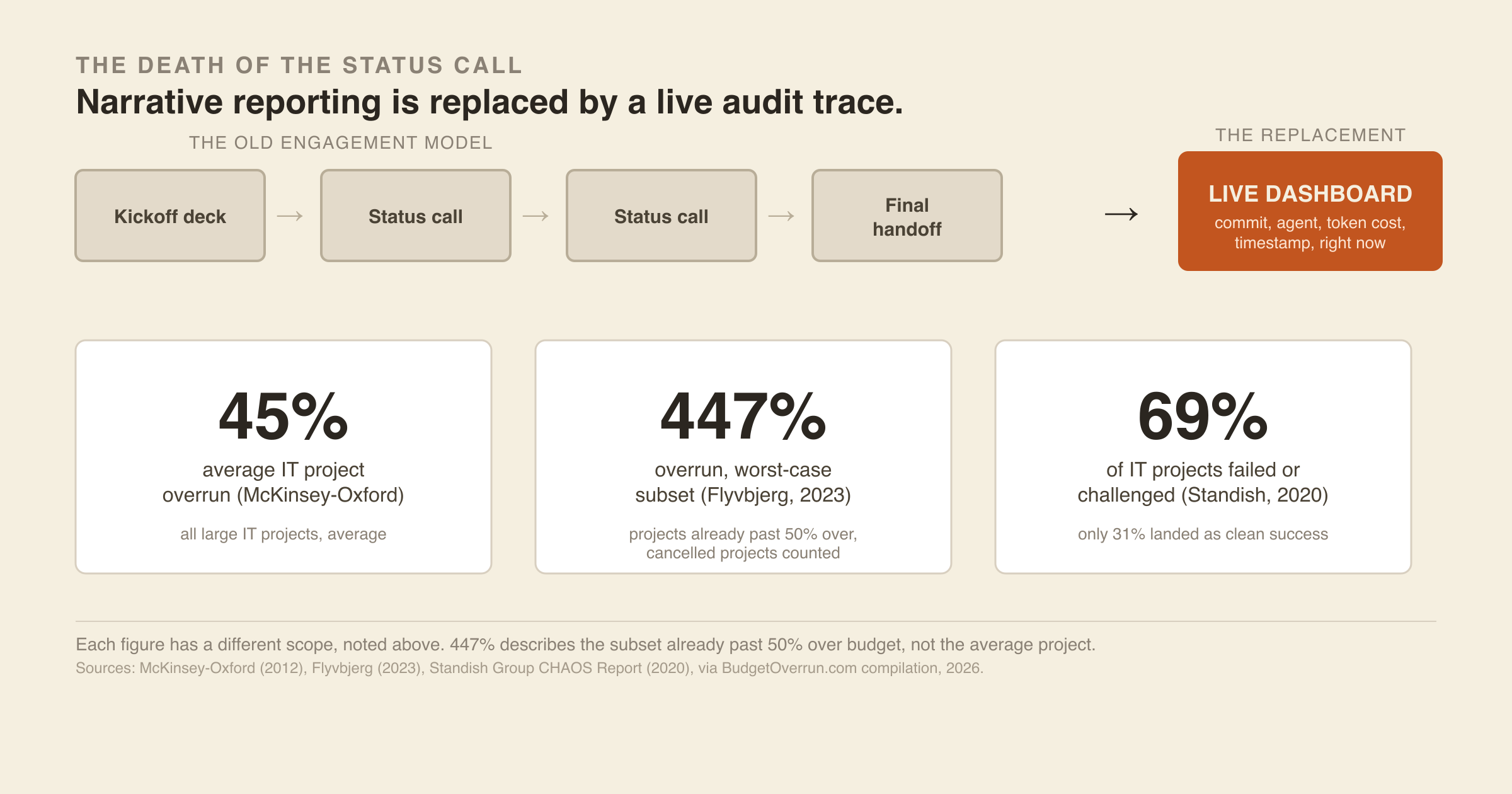
Real-time dashboards are replacing the deck. Audit trace, not narrative, is the new deliverable.
By The Chiri Team
When was the last time you knew, in real time, exactly what your AI consultant had actually built for you that week?
For a lot of companies, the honest answer is close to never. The standard engagement model is a kickoff deck, a few status calls, and a final handoff, with everything in between reported back to you in the vendor’s own words, on the vendor’s own schedule. That was tolerable when “the project” meant a slower-moving software implementation. It is not tolerable anymore, because the thing being built now moves at the speed of an agent writing code, and the standard consulting cadence cannot keep up with what it is supposed to be managing.
The numbers on the old model were already bad before AI entered the picture:
- A McKinsey-Oxford study, now over a decade old but still the most-cited benchmark in the industry, found large IT projects run 45 percent over budget on average.
- Flyvbjerg’s 2023 analysis found the subset that blow past 50 percent over budget average a 447 percent overrun once cancelled projects are counted.
- The Standish Group’s 2020 CHAOS Report puts 69 percent of IT projects as either failed or challenged, with only 31 percent landing as clean successes.
(Project Cost Overrun Statistics compilation, 2026)
Part of the reason is structural. A construction manager can look at a job site and estimate how close a building is to done. A software project manager largely cannot do the same with a codebase, so status updates end up being narrative rather than measurable.
AI does not fix that problem by default. It makes it worse if you are not careful, because now the thing you cannot see is not just a codebase, it is a codebase being written by an agent that can produce a month of a human engineer’s output in an afternoon. A February 2026 survey found that 79 percent of enterprises had an AI cost overrun in the prior twelve months, and the reason tracks with what we just described: the errors that cause the overrun often do not even show up in a billing statement until it is too late to course correct. (DoiT survey via PointFive, 2026)
Why we built our own project management software before we sold anyone else’s
We do not run client engagements off a slide deck and a weekly call. We built our own live project management platform, we call it Waypoint internally, and we run every one of our own engagements on it before anything ships to a client. If we cannot see, in real time, what our own agents are doing on our own projects, we have no business telling a client to trust us with theirs. That is the whole test. We are our own first customer, every time.
What that actually looks like in practice is simple to describe and hard to fake:
- A live dashboard that shows what got built, when, by which agent or engineer, tied to the actual commit and the actual token cost, not a status summary written after the fact.
- Audit tracing that lets you click backward from a finished feature to the exact sequence of actions that produced it.
- No narrative layer standing between what happened and what you are told happened.
That is a different posture from a standard status-call engagement. If your AI consultant cannot show you a live, real-time dashboard down to the individual action, they are not actually operating differently than a traditional systems integrator, they are just a smaller, faster version of one, with less overhead to justify the same lack of visibility.
The dashboard is the deliverable, not the report
The strategic shift underneath all of this is worth naming directly. Consulting has traditionally sold expertise wrapped in a report. What clients are increasingly asking for, and what the market is starting to build toward, is continuous access to what is actually happening, not a periodic summary of it. The industry is already moving from static reports toward interactive portals and real-time engagement platforms, because the pace of AI-built work makes a monthly status deck feel like reading yesterday’s newspaper. (consulting delivery trend coverage, 2026)
The businesses that get this right treat the dashboard itself as part of the product, not as internal tooling they happen to have. It is the mechanism that lets a non-technical executive answer, at any moment, the two questions that actually matter: what is my team getting for this spend, and can I prove it if someone asks.
This is not a nice-to-have for any one seat, it changes what each seat can actually be accountable for:
- The CEO can walk into a board meeting with a real answer instead of a vendor’s summary.
- The CFO can see spend against output before the invoice arrives, not after.
- The COO can catch a stalled workflow in days instead of discovering it at the next quarterly review.
- The CTO gets a technical record precise enough to actually debug against, not a narrative written to sound reassuring.
Take the dashboard away and every one of those people is operating on trust alone, in a domain now moving too fast for trust alone to be sufficient.
If you could not answer that question about your current AI initiative right now, what would you need to see to actually trust the number you would give?
Sources cited:
- BudgetOverrun.com compilation, 2026, citing McKinsey-Oxford (2012), Flyvbjerg (2023), and Standish Group CHAOS Report (2020). https://budgetoverrun.com/it-projects
- PointFive, “Why Companies Overspend on AI: The 2026 Cost Visibility Gap,” citing February 2026 DoiT survey. https://www.pointfive.co/blog/why-companies-overspend-on-ai-the-2026-cost-visibility-gap
- Chitika, “How Consulting Firms Are Using AI to Deliver More Client Value in 2026.” https://www.chitika.com/how-consulting-firms-are-using-ai-to-deliver-more-client-value-in-2026/