
Web3’s most mocked idea just became the only credible way to govern an agent workforce.
By The Chiri Team
If an AI agent in your business took an action at 2am today, could you tell me what it did, what data it touched, and who approved it?
Ask a compliance team how confident they are in that answer today, and confidence usually drops fast the moment you get past “we have logs somewhere.” Six months ago, that was a forgivable gap, one more item on the AI to-do list. Today it is closer to an existential one, because “we don’t fully know what our agents did” does not survive contact with a regulator, an insurer, or a board asking the same question after an incident. The fix is a set of ideas most of us wrote off in 2022 for entirely different reasons.
I know how this sounds. Web3 spent years as a punchline, a solution chasing a use case that mostly turned out to be speculation. But strip away the token launches and the JPEGs, and the underlying technical idea was never wrong: an append-only ledger of who did what, when, resistant to tampering, that does not depend on trusting any single party to keep an honest record. That idea has a real job now. It is agent governance.
Why “trust me” does not scale to a thousand agents
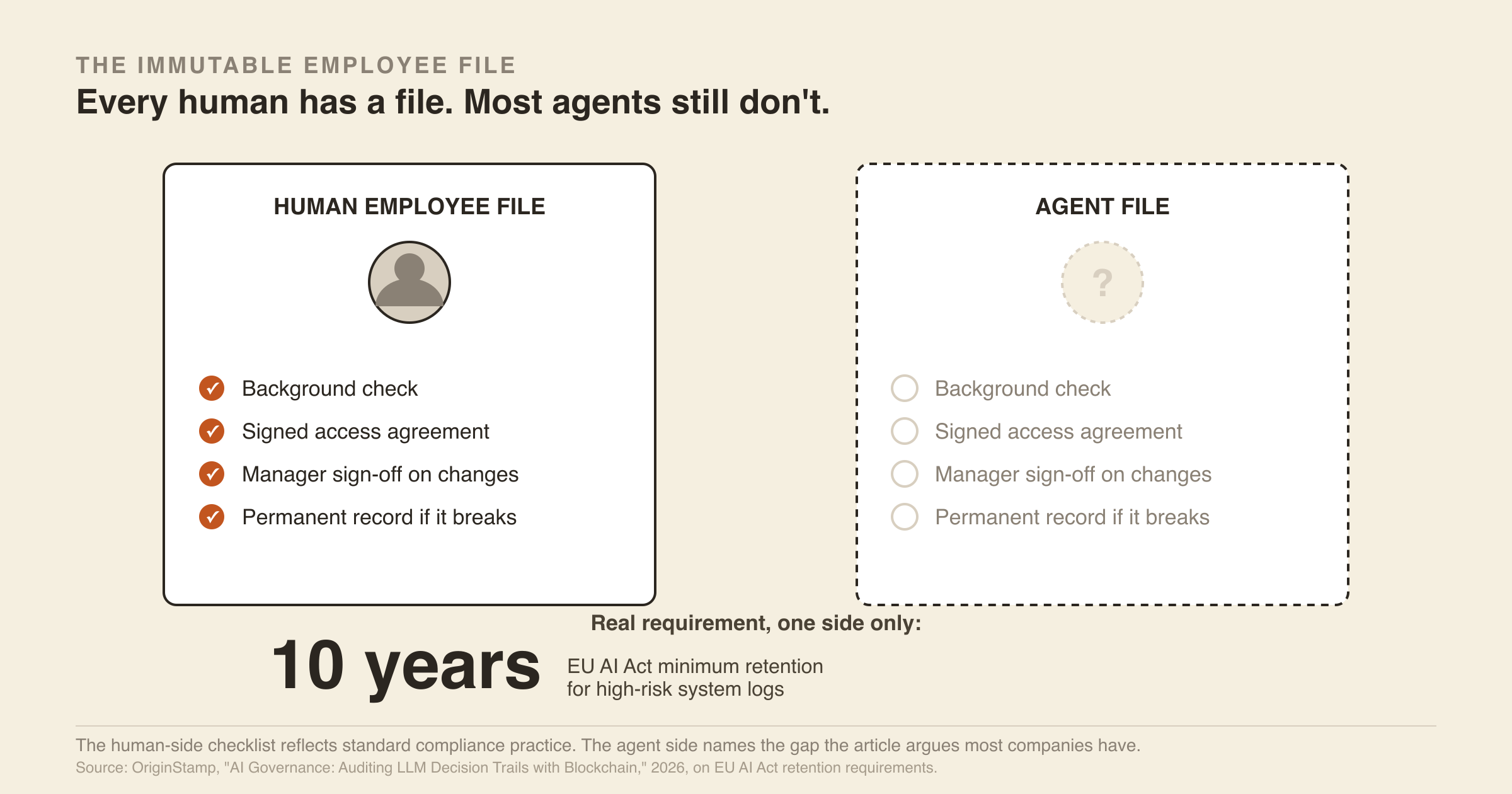
Every human employee you hire has a file. Background check, signed access agreements, a manager who reviews what they touched and when, a permanent record if something goes wrong. Your agents almost certainly do not have the equivalent, even though several of them may already have broader system access than most of your staff.
When one employee has access to a system, you can audit them the old way: access logs, a manager who signs off on changes, a paper trail if something goes wrong. That model was already straining before AI. It breaks completely once a company is running a hundred agents, or ten thousand, each capable of reading data, calling tools, and writing changes faster than any human reviewer could follow in real time.
What you need at that point is not a better dashboard. It is a ledger, with three properties:
- It grows over time without being rewritten.
- It resists the two classic ways a bad actor corrupts a shared record: a Sybil attack, where one actor pretends to be many, and a 51 percent attack, where enough of the network colludes to rewrite history.
- It captures every action, not a sample of them: who did what, to which data, using which app, at what time, at what token cost.
That is not a blockchain pitch. That is a description of what regulators are starting to require whether you build it or not. Under the EU AI Act, high-risk classification triggers mandatory logging, human oversight, and technical documentation that has to be retained for a minimum of ten years. (OriginStamp, “AI Governance: Auditing LLM Decision Trails with Blockchain,” 2026)
A ten-year retention requirement is not a policy detail. It is a bet that whatever system holds that record today will still be trustworthy, and still exist, a decade from now, which is exactly the property an append-only ledger is built to guarantee and a shared drive is not.
Palantir already proved the model. It also proved the limit
Palantir built exactly this kind of system, an ontology that maps an organization’s data, actions, and permissions into something governable and auditable, and it works. It is also priced and staffed for governments and the Fortune 50. Palantir’s FY2025 10-K shows an average customer contract of $4.68 million, delivered through 20 to 40 forward-deployed engineers per major account billed near $1 million a year each, on a customer base that is 55 percent government. (Palantir Technologies 10-K, FY2025, SEC EDGAR) That is not a knock on the product. It is a description of who can actually buy it.
The gap that leaves is enormous. A 400-person logistics company or a regional healthcare group needs the same governance property, an honest, tamper-resistant record of what its agents did, but does not have a Palantir-sized budget or a Palantir-sized problem. That gap is where most operationally complex businesses actually live.
Change management was always the real product
An immutable ledger is not valuable because it is decentralized. It is valuable because it forces discipline around change management, the same discipline every mature IT organization already claims to have and few actually enforce consistently once humans are the only thing keeping the record honest.
Every action an agent takes should answer five questions on its own, without anyone having to reconstruct it after the fact: what happened, who or what triggered it, what data it touched, what the outcome was, and whether it complied with the policy it was supposed to follow. Get that right and you have not just built an audit trail. You have built the exact record a SOC 2 auditor, an insurer, or a new enterprise customer’s security team already asks for today, just applied to a workforce that did not exist when those questionnaires were written.
The technology underneath does not need to be a public blockchain. A mid-market company does not need Bitcoin or Ethereum anchoring to get the same guarantee, applied privately, sized to the business, and priced like software instead of a government contract. That is the actual lesson Web3 has for the agent era. Not the token. The ledger.
This is a different question for each seat in the room, and that is exactly why it stalls without an owner:
- The CEO is the one who has to explain a governance gap to a board or a customer after the fact, in public, without a record to point to.
- The COO is the one who inherits the operational chaos when nobody can say which agent touched which system first.
- The CTO is the one being asked to build this from scratch, usually under deadline pressure, usually after something has already gone wrong.
- The CFO is the one deciding whether to buy a Palantir-scale solution the business cannot really afford, or accept the risk of having no record at all.
None of those are comfortable positions. All of them get easier the day someone in the room decides the ledger is not optional.
What would it cost your business today to answer, with certainty, what every agent in your environment did last week?
Sources cited:
- Palantir Technologies 10-K, FY2025, SEC EDGAR: average customer ACV, forward-deployed engineer model, government customer mix.
- OriginStamp, “AI Governance: Auditing LLM Decision Trails with Blockchain,” 2026, on EU AI Act high-risk system logging requirements. https://originstamp.com/en/blog/reader/ai-governance-auditing-llm-decision-trails